
Sunday, March 2, 2014


Saturday, November 9, 2013
Blue Is The Warmest Colour
 When a Steven Spielberg-led jury awarded the Cannes Film Festival's Palme d'Or to Blue Is The Warmest Colour earlier this year, it served as yet another example of how meteoric a film's rise at Cannes can be. Not selected as an early favorite, the film had become a frontrunner by Festival's end, and the jury took the unprecedented extra step of awarding the Palme to both director Abdellatif Kechiche and stars Adèle Exarchopoulos and Léa Seydoux. I've been particularly excited to see the film, and was particularly pleased at the idea of a film depicting a same-sex relationship getting such a positive response. Even as it becomes much more common, it's just not the kind of thing that happens often enough.
The film tells the story of Adele, a high school student, and Emma, a senior in college, as they meet, fall in love, and make an attempt at "happily ever after." It's a common enough story, but the way it's told is what sets it apart both positively and negatively.
It's hard to get around the fact that Blue Is The Warmest Colour is knocking at the door of a 3 hour running time, with all of the potential for positives and pitfalls that such length engenders. The film gets off to a strong start by focusing clearly on the beginning of 17-year-old Adele's exploration of same-sex attraction. There's a wonderfully effective scene in which she's forced to come to grips with the divide between her own feelings about a classmate and that classmate's feelings for her. I also really enjoyed the way that Adele and Emma first start circling each other. Emma's older and clearly has a much richer life experience, to say nothing of her sexual history. Despite that, she treats Adele with tenderness and affection without seeming to be predatory or self-serving. When they first kiss, it's Adele that initiates it, and it works beautifully.
Unfortunately, after a really nicely paced first hour or so that strikes a really nice tone, the film starts to veer off the rails with missed opportunities, poor stylistic choices, and some rather silly mistakes. After an extended period in which the particulars of their relationship aren't entirely up for public dissemination, the characters are suddenly depicted as being having been together for a year or two. It's a big jump with a lot of ramifications that aren't even touched. It seems strange that a film this long should have have what amounts to a missing section.
Then, once we arrive in domestic bliss and things start to go wrong, there's a level of hypocrisy that I found really annoying. I'll try to be vague. One character gets extremely angry at another for behavior that she herself had been part and parcel to at least once before and is probably guilty of at the same time . . . and it's not even mentioned once, even though it's the logical end to that or some other conversation. While this might be claimed that this is the kind of thing that real people actually do, I'd disagree that the average person wouldn't stand up for himself/herself as much as possible by fighting fire with fire. For the film to go to such lengths to ensure that this discrepancy isn't even mentioned seems to be a really silly mistake, and an unnecessary exploitation of the character who's made a martyr.

Additionally, one of the things that hinders Blue Is The Warmest Colour is the very thing that's supposed to set it apart. The sex scenes. While I've spoken out against the MPAA's unfair use of the NC-17 rating with regard to films like Blue Valentine, this time the adult rating is entirely deserved.
I'm a strong proponent of the idea that almost any word or theme can be used appropriately given the right context. That said, the sex scenes in this one are pornographic. Simple as that. I find it very difficult to imagine that they were entirely simulated, given the graphic depiction of a number of different sex acts and how up close and personal the actors are. I'm not suggesting that pornography is indecent so much as that if I'd wanted porn, I'd have just watched porn.
For me, the purpose of a dramatic narrative isn't to imitate "real life" or try to titillate the senses for its own sake. I have no problem with a little titillation and some discomfort when I'm watching a film . . . if it works in context. While I want to have a bit of a character's life experience illuminated for me in a such a way that either helps me put my own thoughts into context or encourages me to explore new ideas, I do not like to be made to feel like I'm staring.
A few minutes into the major sex scene in Blue Is The Warmest Colour, I started to ask myself what purpose the filmmaker was trying to serve by showing me that amount of raw sex. Does he think that nobody knows how people have sex? Does he think that nobody understands how two women have sex? By the time that the film enters the second extended sex scene (not long after the first!), I rolled my eyes in despair.
It would have been far more effective to show the characters having sex without showing the actors having sex. Nothing would have been lost except for an unnecessarily high level of the "shock factor" that the film tries unsuccessfully to bank on, and it would have gained so much more from a more restrained approach. In contrast to Emma and Adele's first two sex scenes, there's a scene in which the two women have sex in Adele's house and try to keep quiet so that her parents don't realize that they're a couple. It's tender, caring, and so, so sweet. What makes this scene work isn't an overabundance of graphic sex. It's the loving interaction between Adele and Emma. This 3 minute love scene was infinitely more satisfying than either of the overlong sex scenes that preceded it.
It would have been far more effective to show the characters having sex without showing the actors having sex. Nothing would have been lost except for an unnecessarily high level of the "shock factor" that the film tries unsuccessfully to bank on, and it would have gained so much more from a more restrained approach. In contrast to Emma and Adele's first two sex scenes, there's a scene in which the two women have sex in Adele's house and try to keep quiet so that her parents don't realize that they're a couple. It's tender, caring, and so, so sweet. What makes this scene work isn't an overabundance of graphic sex. It's the loving interaction between Adele and Emma. This 3 minute love scene was infinitely more satisfying than either of the overlong sex scenes that preceded it.
 Similarly, there's another silly use of sex that strikes entirely the wrong tone. Toward the end of the film, there's an almost unbelievable scene between the two women in which they nearly have sex in a (very!) public place. For a restaurant to have instantaneously emptied or suddenly been filled with deaf/blind patrons seemed utterly ridiculous and wasted some wonderfully tender dialogue from earlier in the scene.
Ultimately, while the film has two strong lead performances and some truly lovely photography from Sofian El Fani, I think that the blame for the film's missteps should lie at the feet of writer Ghalia Lacroix and writer/director Abdellatif Kechiche. Had this same story been tackled from a different angle thematically and stylistically, particularly with regard to the ridiculous sex scenes, I think that it would have been infinitely more successful.
It's not that Adele and Emma's story isn't a worthy one. It's just that the way it's told makes it difficult to focus on the truth of their relationship. When I'm sitting in the theater trying to communicate telepathically with the characters about extremely basic things that they ought to be thinking about, I think it's a sign that somebody didn't think things through as well as he/she might have. The French title, The Life of Adele, Chapters 1 & 2, implies that there's going to be a sequel, which it's safe to say I don't feel a lot of enthusiasm toward. Here's hoping that, if the story continues, it does so in a way that serves these two characters much better.
A big swing and an unfortunate miss.
2 stars (out of 5)
--------
Click on the titles below for my thoughts on the previous 3 Palme d'Or winners and click here for more reviews of Cannes titles and Festival awards coverage.
Wednesday, November 6, 2013
New Orleans Film Festival
Tennessee Williams once said that only San Francisco, New York, and New Orleans were American cities and that everywhere else was some variation of Cleveland. After checking New Orleans off the list, I'm inclined to believe him, though I hold off some strange kind of soft spot for Los Angeles, the megacity of my nearest acquaintance, despite my dislike for the place.
Where to begin?
Now, onto the movies . . .
First and foremost, our purpose there was to promote the NOFF's two screenings of Bible Quiz, but we had plenty of time to catch a handful of screenings.
Animated Shorts - Whenever I attend a Festival, I try to make a point of going to the Animated Shorts program. For one, it's usually one of the most enjoyable screenings of the entire Festival ('cause who doesn't like to feel like they're 8 years old again?), and it tends to provide a really exciting look at the work of some wonderfully talented people who may not get the recognition that they deserve. We arrived a little late due to attending the filmmaker brunch/awards presentation, but get this . . . the brunch was held in Mardi Gras World amidst all the floats! So, while we missed a few films, I got a chance to see a float that's either the BatBoat or the BatPlane (I'm still not sure). I think I win.
My favorite animated shorts tend to have a tightly focused narrative, are a lot of fun, and don't overstay their welcome. To that end, I was a little surprised to find that a significant segment of the program was devoted to films that were extremely anticlimactic. From a programming standpoint, it seemed a bit odd that they'd all been placed back-to-back-to-back as opposed to being spread out to allow the audience some time to cleanse its palate.
Here are my four favorites from the program. As an added bonus, I was able to find almost all of them online for you, so click on the title to watch the film or see a trailer!
.JPG) Head Over Heels - Easily my favorite film in the program. It's a lovely look about a man who lives on the floor and a woman who lives on the ceiling and the way that they rediscover how much they love each other. Claymation isn't normally my favorite form of animation, but this really worked for me. There's serious magic at work here, folks.
Head Over Heels - Easily my favorite film in the program. It's a lovely look about a man who lives on the floor and a woman who lives on the ceiling and the way that they rediscover how much they love each other. Claymation isn't normally my favorite form of animation, but this really worked for me. There's serious magic at work here, folks.- Chicken Or The Egg - Heartfelt hilarity. This one's about a pig who's addicted to eating eggs . . . until he falls in love with a beautiful hen. Let's just say that he's got some difficult adjustments to make. Directors Elaine Wu and Christine Kim never step wrong here, and I'm excited to see where this one's going.
- Shelved - A great combination of live action and superimposed CGI. A bumbling duo of factory robots are taxed with getting a coworker's farewell card signed only to find that they're all being replaced . . . by humans!
- The Sunshine Egg - 6 minutes of avian existentialism, introspection, and liberation.
.JPG)
Feature Documentaries -
- The Whole Gritty City - Programming this one was a no brainer for the NOFF, as it takes a look at New Orleans' rich tradition of connecting young people and marching bands. The film looks at the way that the marching bands from L.E. Rabouin High School, O. Perry Walker High School, and the Roots of Music provide a source of structure for the kids participating in the program. Each program is blessed with a charismatic band director, and the contrasting ways that each man chooses to operate his program provides for some of the film's most interesting bits.However, while The Whole Gritty City has a lot of passion for its subject, the film's narrative isn't as focused as it should be to achieve maximum emotional impact. For example, there's a character that's introduced near the very end of the film only to be killed off after about 20 minutes. Had this character been a more consistent part of the film, his death could have been a true climax to the film, instead of the almost arbitrary way that it's almost tossed in to cap off the narrative.While the film's compelling enough and has some really great sequences, (including a FANTASTIC rendition of "Stand By Me" by a gargantuan band), it doesn't really manage to be much more than just all right despite its aspirations for greatness.

- Nebraska - I was particularly excited to see that NOFF had the newest film from Alexander Payne, the writer/director of Sideways, The Descendants, and About Schmidt. As the film was completely sold out, we weren't sure if we'd be able to get in, but some time in the rush line, good luck, and our stunning good looks won the day for us.
Unfortunately, the film's a bit of a dud. Phedon Papamichael's black-and-white photography is lovely, but with the exception of Bruce Dern's solid performance, the whole thing has its tongue so firmly embedded in cheek that it's just about to be sticking out the other end. Essentially, if one was going to try to write a campy parody of life in small town Montana, this is exactly the kind of dialogue that would result. Now, if the performances were better, the material might have worked, but the actors play the jokey material in the most stereotypical way possible. There's a scene where Dern's son meets his father's high school sweetheart, and it's written and played EXACTLY the way that you'd expect from a writer trying to have a little fun at the expense of these small town folks. Unfortunately, while the second half rebounds from the lackluster start, too much of Nebraska feels tone-deaf instead of hitting home. - A Will For The Woods - this one was an emotional roller coaster like few films I've seen in recent years. Tackling "green burial," a topic I knew next to nothing about, through the eyes of Clark Wang, a man I'd never heard of, the filmmakers have a clear vision of exactly what they want to say and they're adept at painting a good picture of a vibrantly funny guy.Where the film goes wrong (though I hesitate to use that word) is in its relentlessly sad final act. It's obvious from the outset that lymphoma will kill Clark, but his family and friends grieve in such a way as to make their sorrow almost tangible. I could literally hear the people around me breaking down, and eventually, I was one of them.I certainly don't have anything against a filmmaker attempting to tackle subject matter that's not sunshine and rainbows, but the way that the film lingers on grief becomes, albeit unintentionally, almost morbid. They wash, anoint, and sing to the body and his widow sleeps next to the casket on an air mattress in the living room.I'm certainly not saying that everyone's expression of grief is or should be the same. If you're doing what works for you, it's not my place to tell you that you should be doing something different. . . but given my recent past, this film was just too persistently sad for me to be able to recommend, despite the fact that it's very well-made.

Going to a Festival with a film's team instead of being there just to scout films was a really interesting experience. I was able to take in a lot of the city and was very lucky to have my good friends Nicole and Katie there to share it with. I'm really grateful to have been invited to be a part of the Bible Quiz tour, and that the audience proved so responsive to the film!
Having the opportunity to eat beignets at Cafe Du Monde, drink Hurricanes at Pat O'Brien's, and eat po' boys and muffelattas and watch the sunset over the Mississippi and watch a group of midnight drunks try desperately to find the beat to "Bohemian Rhapsody" and wander the streets of the French Quarter in search of a veggie po' boy and make sermons out of pop songs and find ourselves at a square dance on a Monday night . . . was fantastic! We also just might have been the people walking down the street (sober!) with the lyrics to Lorde's "Royals" pulled up on somebody's cell phone in order to serenade whoever might have been listening.
Yep, that was definitely us.
--------------
I'll be attending AFI Fest (my favorite fest!) next week and will be posting a wrap-up of the films I see when I get back, so keep a weather eye out for that!
Wednesday, October 9, 2013
A New Adventure!
Exciting news!
This weekend, I'll be heading off to the New Orleans Film Festival to join the crew of Bible Quiz to support their screenings there. As you might recall, I first saw the film at Slamdance, and had the chance to spend some time with them in the bitter cold. A few months later, I was lucky to be able to bring the film to the Festival I program for. It was the rare occasion where programming didn't just expand my rolodex so much as it saw me make new friends.
Imagine my surprise to get the invitation to come out to the Festival this weekend! I've never been to New Orleans before, and we're planning to do a fair bit of exploration (and eating, eating, eating) in addition to seeing as many films as possible. While I've been to my share of Festivals for my job, I'm particularly excited to be attending a Festival with a film's team, which is a first for me. I'm looking forward to pitching in however I can!
At this point, I'm not entirely sure if I'll be posting each day a la the Tales from Park City or SmackDance columns, or if I'll tackle everything in a big wrap-up post when I get home next week. There will definitely be tons of pictures!
If you've been to New Orleans and have favorite places to visit, leave a comment and let me know!
------
Sunday, October 6, 2013
Gravity
At the end, I've embedded the fantastic trailer.


-----

It’s hard to believe that Alfonso
Cuaron hasn’t made a film since 2006’s Children of Men, easily one of the
young century’s best. Like many films that I write about here, I’ve had my eye
on Gravity
for years. Cuaron, one of contemporary cinema’s brightest stars, brings a
unique sensibility to each project, and his creative
collaboration/partnership/brotherhood with Alejandro González Iñárritu and
Guillermo Del Toro is one of the single best things in the movies today.
Here’s the scoop: after a missile
takes down a Russian satellite and causes a storm of debris to hit an orbiting
American space shuttle, the surviving astronauts must find a way to survive.
I’ll avoid saying much more. You deserve to learn the rest for yourself.
The viewer’s immediately reminded
that Cuaron doesn’t do things like most “ordinary” filmmakers. From the film’s
first moment until one character’s climactic tumble out into space, there are
no cuts. None. Now, I recognize that the number of visual effects being used in
this particular shot make it a bit easier to wrap one’s head around than a
similar shot in a film like Atonement, but it’s something that’s
nearly unparalleled in the contemporary cinematic landscape. Furthermore, the
3D’s really well done, and enhances the experience considerably. As someone
who’s not usually a big fan of that particular gimmick, I would highly
recommend that you shell out the extra dough. Think of Avatar’s “window” as
opposed to the atypical “Oh no! A rock! Flying at me!” that you get from a lot
of other 3D “experiences”.

Gravity is a survival
story, simple as that, and it’s a damned good one too. Above all, it’s a tour
de force for Cuaron’s masterful direction and Emanuel Lubezki’s peerless
photography. I’ve spoken before about Chivo’s stunning work with Terrence
Malick in both The Tree of Life and To The Wonder, and it’s equally
astounding that he and Cuaron are able to work together so well. Essentially,
I’m wondering if he’s the best ace-in-the-hole around.
From a technical perspective, Gravity
is a masterpiece. The camera moves with remarkable grace through the expanses
of the earth’s atmosphere as well as some claustrophobic interiors that I won’t
say much about. More than anything, one is reminded of just how big
space is and how foreign it is to anything at all like life on earth. Having
grown up on Star Wars, Star Trek, impulse engines, warp drives, and automated
docking systems, it’s refreshing to see something that communicates to dazzling
effect just how difficult it is to take one object in space and get it anywhere
close to another object in space. When a character is sent tumbling through
space, it’s really scary, because you realize for the first time (unless you’re
smarter than I am) that in space there’s very little to slow you down. Additionally,
there’s a level of understatement with some of the film’s more unsettling shots
that I admired.
I also particularly admired the
sound design. In space, one wouldn’t exactly hear something approaching
quickly, and there were a number of times where I cringed at the realization
that a character had no idea of what was coming at them hot and heavy. Steven
Price’s music is reminiscent of Jonny Greenwood’s recent film work, as well as
the scores of Trent Reznor and Atticus Ross, though Price relies a bit more
heavily on traditional scoring techniques.
With regard to narrative, the
film’s limited scope is one of the best things about Gravity, as well as the
one thing that holds it back. 127 Hours comes to mind, but where
that film used flashbacks to expound upon the story of a man trapped between a
rock and a hard place (yep, went there!), Gravity confines itself exclusively
to the narrative’s “present.” As such, while there’s a LOT of edge-of-your-seat
suspense, there are a few times where I just didn’t feel like the characters
had been developed to the point that I’d have liked to be able to fully
empathize with what they were dealing with. I’m not suggesting that there
aren’t some genuinely affecting moments. I’m thinking of two that really moved
me, one near the conclusion and the other involving an impromptu crank call of
sorts that ends in the loveliest way. I’d just have appreciated a little more
of an opportunity for emotional involvement. That said, I’m grateful that
Cuaron and his co-writer, Jonas Cuaron, decided to keep things in the moment
and avoided the ubiquitous use of the flashback, which I think a lot of other
filmmakers would have opted for very quickly.
Gravity is one of the
year’s best films. If you have recently complained at all about the
oft-lamented (perhaps overly so) deficit of original content in the movies
today, the creative audacity and sheer scope of Alfonso Cuaron’s new film will
do more than a little bit to restore your faith in where the movies are headed.
4 stars (out of 5)
-----
Monday, August 12, 2013
Blue Jasmine
At the end, I've included the synopsis and embedded the trailer.
-----

If you’re going to knock Woody Allen films, or at least
recent Woody Allen films, there’s the easy criticism that a certain
self-satisfaction exudes from some of the characters. They’ve been born into a
world of art galleries, yachts, ridiculously expensive bills from restaurants
named after French dudes, and they’re not exactly apologizing for it. This isn’t
to say that the films don’t have their share of people like you and me (unless
you’re one of those people who just loves Louis’ or Paul’s or whatever), but
only that there seems to be clear delineation between their world and our
world, between us and them.
That’s something that sets Blue Jasmine apart in a way that
I hadn’t anticipated. It’s relentless in the way that it deconstructs the myth
of the spoiled trophy wife. This isn’t to say that the script is merciless, as
there’s a fair bit of compassion for the central character, but I have yet to
come up with an Allen film that’s been this focused in its attack on the vapid,
out-of-touch isolation of a privileged lifestyle gone wrong.
In many ways, I almost read Blue Jasmine as a response to
Allen’s critics, however unconscious and unintentional that might be. There’s
almost a marked attempt to use his weaknesses as strengths. In addition to the quasi-microscopic
take on privilege that I mentioned before, there’s another thing to contend with.
Cate Blanchett.
Her performance is one of the best I’ve seen her give. What’s
more, it’s not only one of the best in an Allen film in recent years, it’s one
of the best performances that’s ever graced one of his films. Woody’s penchant
for writing female characters that go on to win awards for their actors isn’t
exactly a secret, but these tend to be for showier roles that in many cases
play toward Woody’s penchant for characterization that feels mannered and
somewhat artificial. It’s not that the characters aren’t fabulously written and
performed well so much as they feel
fabulously written and the performances are trying hard to match that with
whatever level of histrionics might be needed.
That’s what really sets Blanchett’s performance apart. She’s
walking a razor’s edge between sanity and hysteria, trying desperately to stay
on the right side. Other Allen characters talk to themselves because they’re
nervous and neurotic and are trying to fill the audience in on things. Jasmine talks
to herself because she has to, because her world has been so drastically turned
upside down that she’s alone and adrift in a place where she has virtually no
frame of reference. It’s that delicate balancing act that elevates her work in Blue
Jasmine. It doesn’t come across as showmanship for its own sake so much
as the action of a desperate person who has no idea what to do. For example,
upon arriving in San Francisco, her sole “career decision” is to take a
computer class so that she can “study interior decorating online.” Hey, forward
momentum is good, but her affinity for announcing this to whoever asks her
anything about her future is so sad in a misguided sort of way. She has no idea
how silly she sounds. It breaks your heart a little bit.
Blue Jasmine also features strong work from Sally Hawkins
(one of my favorites) and Louis CK. Their flirtation had me saying “awww” over
and over again. Woody and Casting Directors Juliet Taylor & Patricia
DiCerto deserve kudos for casting someone like Hawkins in such a big role, who’s
yet to really break through in the United States. Here’s hoping that this role
changes that!
As Woody’s first true dramatic film since 2007’s Cassandra’s
Dream, Blue Jasmine succeeds best as a character study. As a whole, I
think that some of the performances still feel a bit mannered, which detracts
from the sense of realism that I think would have elevated it even further.
That said, it’s an engaging look at a truly interesting person and, what’s
more, you won’t be completely prepared for where it ends up. If it’s not a
great film, Blue Jasmine is still a very good film. This massive Allen fan will
take whatever he can get.
4 stars (out of 5)
-----
"After everything in her life falls to pieces, including her marriage to wealthy businessman Hal (Alec Baldwin), elegant New York socialite Jasmine (Cate Blanchett) moves into her sister Ginger’s (Sally Hawkins) modest apartment in San Francisco to try to pull herself back together again." (from the official site)
Thursday, July 11, 2013
Pacific Rim - Immediate Reaction

Pacific Rim is visually vibrant, wonderfully entertaining,
and surprisingly effective from a narrative standpoint. I’d had my reservations
about just how compelling a “monsters vs. robots” story would be. Fortunately,
the cast of lesser-known actors does (mostly) solid work making a larger than
life story seem realistic enough. Charlie Day and Burn Gorman, in particular,
are a lot of fun as the Jaeger program’s “research division.” It’s always nice
to see Rinko Kikuchi (of Babel fame), even if her
performance is hindered a bit by not being able to utilize her native tongue.
I saw the film in 3D, but it’s not one that I think really
does much of anything special with the format. That said, the film’s got a
really diverse color palette, which is nice to see. So many times, futuristic
stories tend to lay on the drab grays pretty heavily. Additionally, this is one of the few films to effectively use the droning boom made far too popular by Hans Zimmer's score for Inception.
Look, I’m not one of the Guillermo Del Toro faithful,
convinced that he can do no wrong. In fact, the marvelous Pan’s Labyrinth aside, I’m
woefully understudied in his filmography. That said, this is a welcome sight in
the world of the summer blockbuster. It’s not a sequel, adaptation, or remake,
and the film (and the audience) is all the better for it.
In a nutshell, Pacific Rim is a rousing good time, filled with imagination to spare. When these robots start using the objects around them to attack the evil "Kaiju," it's a grand sight to behold. There are moments herein that
will make you clap your hands with joy and maybe even cheer a little. We all
need that, don’t we?
4 stars (out of 5)
4 stars (out of 5)
Friday, May 24, 2013
Before Midnight - Surviving "Happily Ever After"

------
I’ve already told you about my
experience of seeing Before Midnight at Sundance. While I
had a lot to say about the film back then, I didn’t want to post it all back in
January given the fact that so few people had seen the film. Since only a small
number of people would be able to read and discuss with me, I thought it’d be
more fun to hold off until we could all commiserate together. This isn’t a
straightforward review so much as it’ll be a series of impressions and
thoughts.
Ethan Hawke’s Jesse and Julie Delpy’s Celine have come to
mean a great deal to me. When I first saw Before Sunrise, I was surprised by
how close I felt to these characters. They felt three-dimensional, and it’s
entirely due to the dialogue-heaviness of the script. You have a chance to hear
exactly what they think about so many things that you feel like you actually
know these people in some way, almost like they were friends of mine. I really
wanted to know what they might have thought about various things, and found it
fascinating to see the way that they changed over time.
In the 9 years between Before Sunset and Before
Midnight, I’d often wondered what had happened to Jesse and Celine. The
last time we saw them, they’d reconnected after 9 years (sensing a motif here?)
and the future of their relationship was in doubt, to say the least. That
ending! “Baby, you are gonna miss. That. Plane.” This time around, I made a concerted
effort to keep off of any internet forums or the like that would tell me the
setup for the new film. I didn’t want to know how Jesse and Celine found
themselves on the same patch of real estate and I’m so glad that I did it that
way, because the revelation was one of the best gifts I’ve received in years.
After an opening sequence in a Grecian airport between Jesse
and his visiting son (he’s so old now!), the camera follows him from behind as
he walks outside as he walks to the car . . . and there she is. I’ve often
described it since as feeling like a 13-year-old girl on the inside. The
thought that they’d found a way to live happily ever after was almost too
wonderful to imagine. “Oh, they lived happily ever after!!!” The rest of the
film pokes some holes in that theory, but the idea that the end of the second
film was not the end of their relationship is beautiful.
Throughout the film, there are a few little easter eggs
dropped about what their life has been like. He really did miss that plane, and
they blacked out the windows to have sex for days. After he got divorced, the
two of them ended up moving to New York for 2 years before moving to Paris so
that their twin daughters could be born there, which apparently almost killed
Celine. They have never married, even though she has told her kids that they
did.
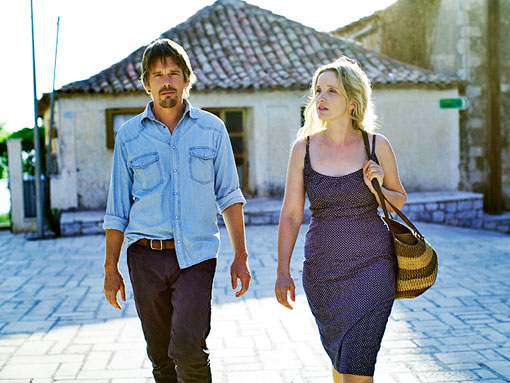
It’s strange to see these characters in middle age. In some
ways, I don’t think that Jesse’s ever really changed. He’s still idealistic,
believing in true love and the idea of accepting a person exactly as he/she is
without trying to make significant changes. I feel as though Celine has changed
the most. She’s hit real life, and she’s hit it HARD. He has the luxury of
remaining committed to his ideals through his writing, but she’s in the
nitty-gritty reality of being a mother and wife (in everything but name). But
even that’s not entirely true. She works all day and he stays home to write.
It’s not like their relationship is founded in inequality as much as she thinks
it is. Still, there’s something there that I identify with that a lot. I know a
lot of people who like to deal with these abstract concepts at the exception of
reality. I often want to shake them til they rattle to get it across that they
only need to listen to what they’re saying to have some idea as to how little
what they’re talking about has any bearing on the life of a regular person.
Plus, thinking about these abstract concepts all the time doesn’t make one
exceptional in any way other than that the corresponding person is often
incredibly annoying.
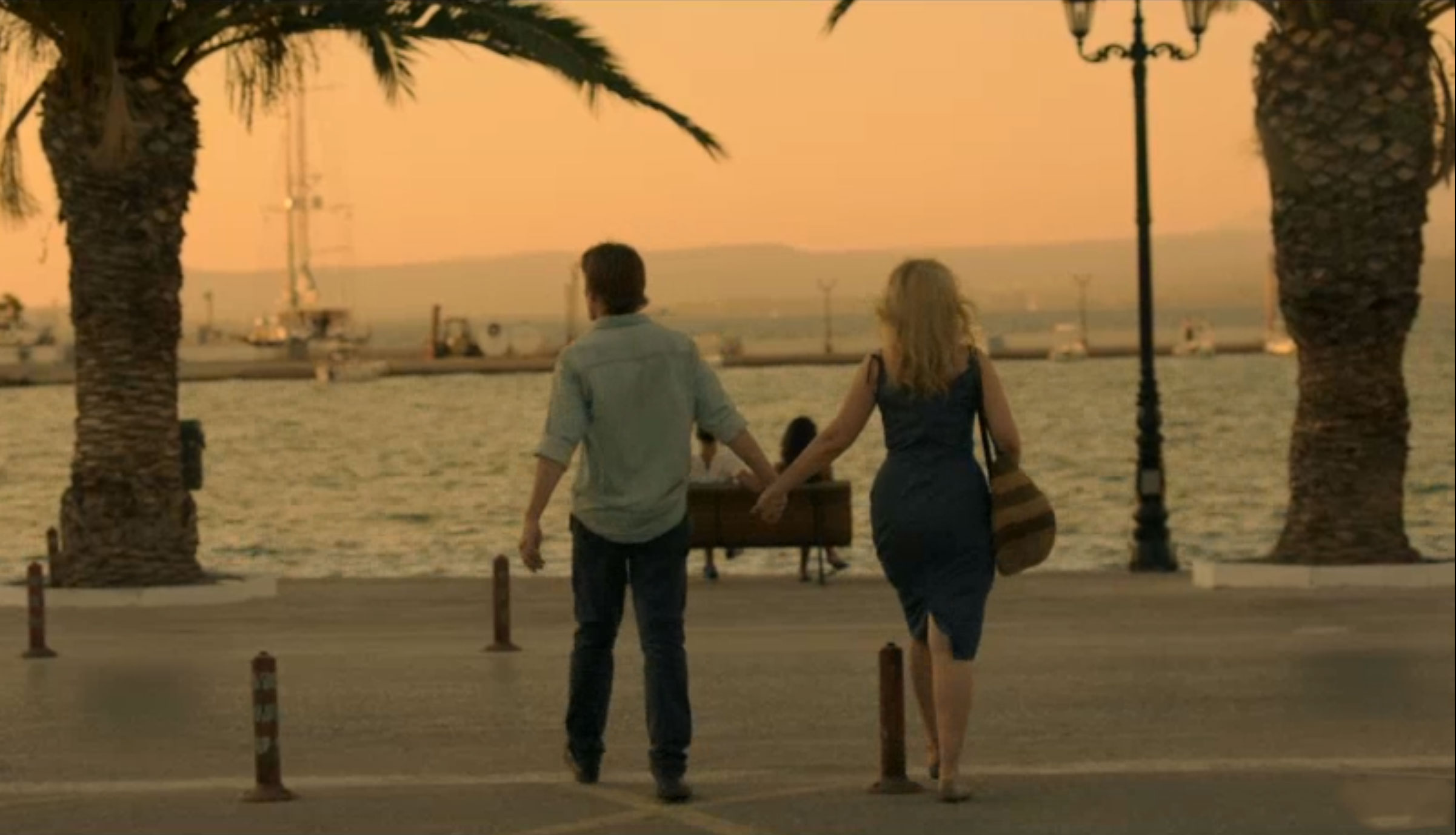
The walk through to the hotel is the most reminiscent of the
previous films. The signature two shot of Jesse and Celine walking and talking
is one for the books. The amount of work that it must take for Hawke, Delpy and Richard Linklater to
not only write that much dialogue but figure out a way to make it feel like it’s
coming off the cuff is astounding. I like the way that their hands keep
flirting with each other like little sparrows.
The scene in the hotel room is one of the most distinctive
in the entire series because, for the first time, we really see Jesse and
Celine get into it and the gloves are OFF. In the previous two films, they’ve
just been so happy to be together that there’s not really any conflict and they
quickly find a way to overcome what little there conflict there is. Here,
they’ve been together for 9 years, and are trying to figure out what the future
holds. Much of the time, I felt like Jesse was getting a raw deal, as he only
wants to talk about the idea of moving to Chicago to be close to his son and Celine’s
convinced that he’s trying to destroy her happiness. I don’t think that’s
entirely fair, but it’s clear as time passes that she really does feel trapped
in their relationship and he doesn’t realize exactly what he’s doing (or NOT
doing). They went through a lot emotionally over the course of the first two
films, and it’s apparent that they’ve been through a lot in the time since.
In the last scene, he re-enacts their meet cute, and it’s
sweet to see him try to tell her yet again that he loves her completely and doesn’t
want to throw that away even after she’s told him that she doesn’t think that
she loves him anymore. Ironically, it’s only after he resigns himself to the
fact that maybe they’re through that she looks at him and asks “so what about
that time machine?” I think she knows deep down that he is her last, best hope
at being happy. As angry as he makes her, I don’t think there is anyone she
would rather be with. I don’t think that this is their last knockdown drag out
fight. Even with the most unequal of relationships, it can be surprising to see
the kind of almost desperate need that two people have for each other. I’m reminded
of Johan and Marianne in Scenes From A Marriage. Despite the terrible things that they say and do to each other, you know that they will never find a way to be two separate people. Fortunately, Jesse and Celine never take it quite that far.
Seeing these two caught up in real life is something kind of
strange. In the first two films, they’re either just meeting for the first time
or are reuniting after many years, whereas here, they’ve been together for
years and are trying to live out the peace. The reality is never as simple as
the fantasy seemed. The future's here and it hurts. Surviving “happily ever after” is not nearly as easy as
it might have seemed in the other movies. Even if it's only until the next fight, I'm really glad that the two of them
seemed to figure things out. The idea
of them splitting up is almost too terrible to think about, at least for long. Jesse
and Celine have traversed a lot of emotional territory over the course of the
18 years we’ve known them, but the love that they’ve built up is more important
than the little things that drive them crazy. It might be a cliché, but Emerson
was right. The things that unite us are stronger than that which drives us
apart.
Love is hard. Even if you’re lucky enough to find it, the
holding on can be the most difficult thing that you’ve ever had to do. People
don’t stay the same and the emotions that they feel often undergo a
transformation that, although it might seem glacial, can result in a change so
severe as to bring even the mighty to their knees. But you know what? If Jesse
and Celine with all their fighting and drama and joy and misery can find a way
to be happy, then maybe the rest of us can too. That's a comforting thought.
Thursday, May 9, 2013
Podcasting: Iron Man 3

A little movie called Iron Man 3 hit the big screen last weekend and promptly started making a LOT of money. I'm just sitting here quietly, waiting for my back-end points from the total gross in Zimbabwe to start to add up. I've got a lot riding on this one!
I wasn't able to be a part of the main episode, but was lucky enough to be a part of a pretty terrific additional segment where we got into some spoilery territory (right after I introduced Aaron to Moulin Rouge! for the first time!)
Don't forget to share/post/link/tweet or whatever it is you do with things you like. Enjoy!
This episode features:
- Aaron Neuwirth of The Code Is Zeek and Why So Blu?
- Abraham Moua of The Walrus Moose
- Brandon Peters of Naptown Nerd
- Germain Lussier of SlashFilm
Sunday, April 14, 2013
To The Wonder

Terrence Malick is the rare artist who knows exactly what he wants to say, and is able to take all of the time he needs to say it. Never one for being bound to someone else's ideas of what he should do, he's marched to the beat of his own drum almost from the get-go. Unfortunately for us, that means he's only released 6 feature films in 43 years.
So, when word got out that his next film was releasing only 1 year after 2011's The Tree of Life, one of the most stunning films of recent years (and, in the eyes of this critic, the best of that year if not of the young century), we rejoiced.
To The Wonder tells the story of 4 people. A Midwesterner (Ben Affleck) and a Parisian (Olga Kurylenko) fall in love, and their relationship turns turbulent when they move back to the United States. When they decide to spend time apart, he begins a relationship with a local woman (Rachel McAdams). All the while, the local priest (Javier Bardem), tries to serve the community while dealing with a crisis of faith.
My expectations were high, particularly given the film's two spellbinding trailers (found here and here). With his last two films, Malick's gotten to a point that his trailers would be Academy Award winning short films if they were released as such.
Unfortunately, To The Wonder suffers from a lack of narrative cohesion. I think that a lot of it has to do with Malick's reliance on voiceover. I'm a big fan of the technique when it's incorporated well, but it's used to excess here. There's very little actual dialogue present, and that hurts the film. When Affleck and Kurylenko are arguing, I'd really like to hear what they're arguing about instead of listening to ambient music and her voice speaking softly about how much he completes her.
It's frustrating, because you get to a point where you just want the characters to stop talking about what's happening and start telling you what's happening. I found myself asking a few fundamental questions that additional dialogue would have aided immensely. Why do these women fall for Affleck's character? He's moody, not terribly supportive, and even abusive. Why would anyone treat Kurylenko's character badly? She's vivacious, sweet, and so wholly devoted to him that it boggles the mind that he wouldn't move heaven and earth to keep her near. Instead of expository dialogue, what we get is whole lot of brooding, glowering, staring, and slow turns around one another like some kind of extremely subdued flamenco.
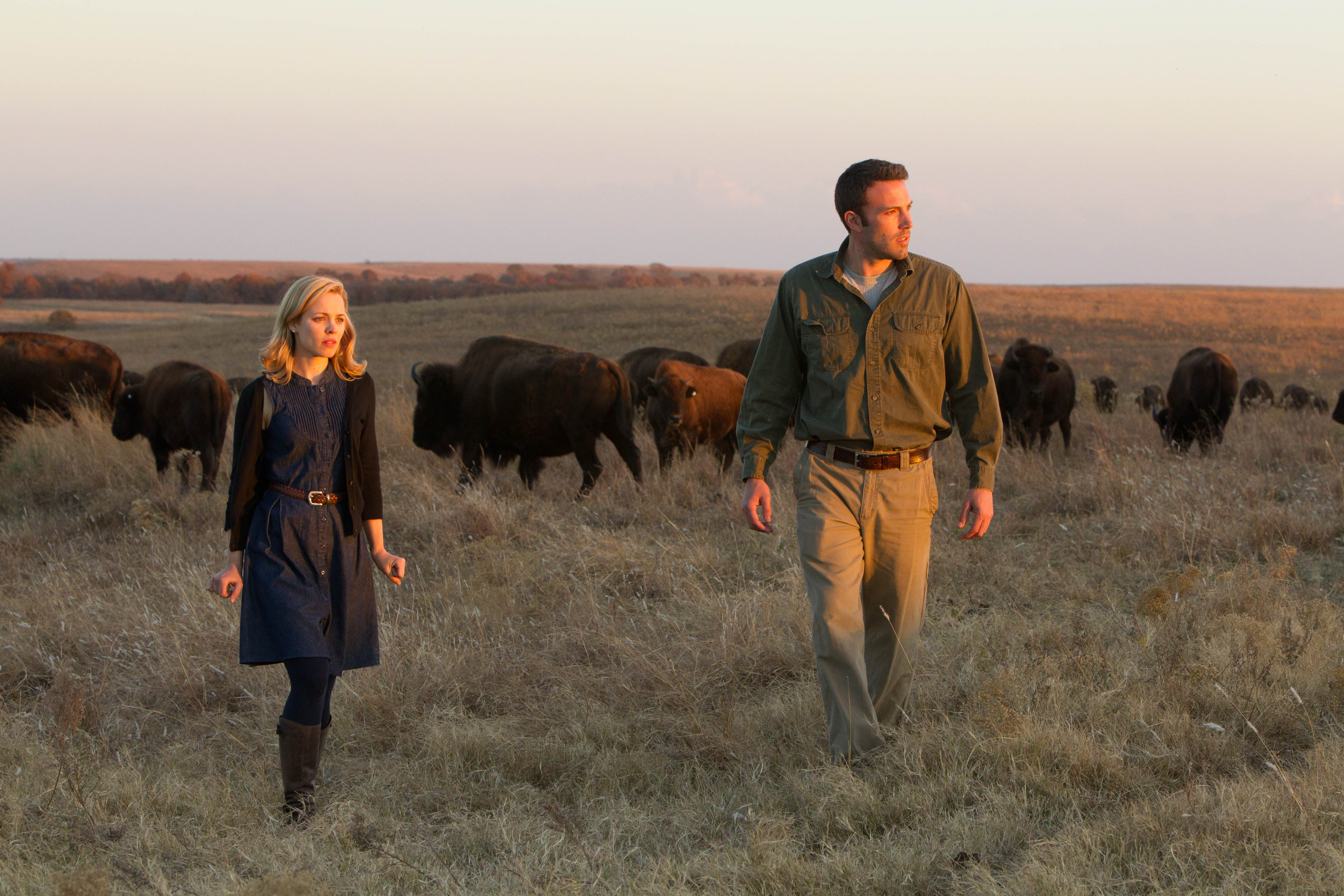
There are certain aspects of the film that are first-rate. The photography is fantastic. If they continue their collaboration, Malick and Emmanuel Lubezki might go down as one of the all-time great director/cinematographer combos. There are individual shots here that will take one's proverbial breath away. In particular, there's one particular shot of dancing light reflected off of a chandelier that literally made me sit up and stare at the screen in wonderment.
The performances by Kurylenko and McAdams deserve praise, particularly given how thin the plot seems to be. In particular, Kurylenko's performance is extremely solid. In the absence of dialogue, her face communicates a wealth of emotion.
I also really liked Bardem's character. In a time when Catholic priests certainly haven't been regarded in the most positive light, his character is a fundamentally good man who cares deeply about serving his community. While I liked the bits about his crisis of belief, I found myself surprised at how heavily the film comes to communicate a heavily Christian message toward the end. From what little I know of him, I believe that Malick is a Christian himself, but I found such a pointed message to be a bit of a strange choice, particularly given how universal the spiritual themes were in The Tree of Life.
Additionally, there are individual sequences that highlight Malick's abundant gifts as a filmmaker. In particular, the film's closing sequence is beautiful. It involves a woman walking, walking, walking before finally turning to see something. At that point, I felt as though I were in a place that I knew. I only wish that the rest of the film had seen that kind of cohesion.
Malick's come to a place where he's not terribly interested in conventional notions of plot and story structure. I understand (and applaud!) that. The problem arises when he doesn't leave enough bread crumbs for the viewer to be able to put the pieces together in any kind of a meaningful way. Here, as in The Tree of Life, Malick employs a kind of omnipotent perspective. While it mostly seems to move forward in one fairly consistent timeline, To The Wonder does skip around in a way that confuses things, particularly toward the end. In the face of many seemingly needless contradictions, my friend and I were abundantly confused about what the state of Affleck and Kurylenko's relationship was when the film ended.
I certainly don't regret seeing the film, but while a film from Terrence Malick is always worth the effort, To The Wonder seems to me to be a big missed opportunity. That said, I look forward to further reading and discussion in the hope I'll be able to find further illumination.
2 1/2 stars (out of 5)
Friday, April 5, 2013
Roger Ebert (1943-2013)
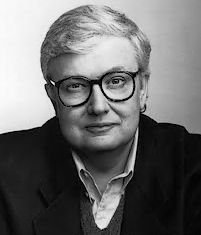 How do you encompass your feelings about someone who meant
so much to you? I don’t know if it’s possible, but I’ve got to try. Roger Ebert
was the only film critic I ever really loved. I’ve got a bunch that I respect,
still more that I enjoy reading/listening to, but Roger was the only one that I
loved. To read his work was to drink deeply at the well with someone who knew a
lot about what he was talking about and had the grace to want to share it with
you in a way that you could understand.
How do you encompass your feelings about someone who meant
so much to you? I don’t know if it’s possible, but I’ve got to try. Roger Ebert
was the only film critic I ever really loved. I’ve got a bunch that I respect,
still more that I enjoy reading/listening to, but Roger was the only one that I
loved. To read his work was to drink deeply at the well with someone who knew a
lot about what he was talking about and had the grace to want to share it with
you in a way that you could understand.
I knew that I loved movies from a young age, and was fairly
excited to learn that I could turn that love into a Bachelor’s Degree. I took a
strange path to that degree, caused in some ways by my own timidity coupled
with some stubbornness and a desire to avoid a heavy workload. There is some
debate about exactly what the word “heavy” means in this context. Anyhow, I
found a way to graduate while avoiding the classes that would force me to watch
a ton of movies every week, having seen fellow students struggle to keep up and
not wanting to be pushed into watching films that I didn’t want to.
I’d been a fan of “Siskel and Ebert” and later “Ebert and
Roeper,” and had read Roger’s work for years, but something changed around the
time I graduated from college. In reading more of his work, I wanted to start
watching the movies that he was talking about. He didn’t just talk about movies
from the last year or two and he didn’t just talk about American films. He
talked about all kinds of films from all over the world and, if he loved the
movie he was talking about, he passed that enthusiasm along. He was looking at
films in a larger context than anyone else I was familiar with at the time. It
wasn’t important what language was used, how much money was made, or how famous
the filmmakers were. It only mattered if the film was good or not, and if that
film had something of value to say about the human experience.
So, armed with Roger’s Great Movies list, a Netflix
account, and an open mind, I started making my way through the films that he thought were
important. It’s safe to say that I might not have encountered Kieslowski,
Antonioni, Godard, Herzog, Bunuel, Truffaut, the Dardennes, or Ozu if not for
Roger. It’s possible that I might have found them through some other avenue,
but I wouldn’t have experienced them in the same way.
Roger had become my teacher. Many is the time I’ve watched a film from his list, found myself either bewildered or unconvinced, and turned to his writing to provide illumination. I will not say that my mind has been changed each time, but I almost always felt that I understood the film better after reading what he had to say.
I think his real gift as a critic came from the way that he
thought about characters. In his mind, they were supposed to be real people,
and that formed a large part of the foundation for his appreciation or aversion
to a particular film. He would find ways to contextualize a character’s actions
in such a way as to make you realize not only what was happening but also the
magnitude of something that might have slipped right past you.
He fought against cancer for eleven years. He was a lucky
man to have been able to hold it off for so long. If he was great before that,
he became something different altogether after the surgeries that robbed him of
his ability to speak. Left with no other recourse, he wrote and wrote and
wrote, and it wasn’t only about the movies anymore. His blog was a thing of
beauty, a mind in full flight, unfettered by limitation and filled to the brim.
The first time I ever got to go to a Steak N Shake (years ago around 1 AM
somewhere in Kentucky), I only had any idea of its existence because of the many
times that Roger had gone into depth of his love for the place.
I never met him, but had the chance to speak with him once a
few years ago through the web. He’d written a blog entry about Bergman (I
think), I commented, and Roger responded. I’d read his blog since the
beginning, but this was the first time that he’d ever responded to one of my
comments. It meant a lot. Roger read and vetted every single comment on his
blog, but only responded to a few. That one of mine got a response is something
that I’ll always treasure.
As a film critic, I don’t think that you can do any better
than Roger. More than that though, I think that he was a thoroughly decent
person, and my heart goes out to his wife and family tonight.
Death is never easy, but part of what makes this so strange was the tone of last blog post, "A Leave of Presence." Even as talked about the recurrence of cancer in his body, he seemed to be so full of life and, more than anything, hope for the future. I had no idea that he was so close to the end. Maybe he didn't either.
Death is never easy, but part of what makes this so strange was the tone of last blog post, "A Leave of Presence." Even as talked about the recurrence of cancer in his body, he seemed to be so full of life and, more than anything, hope for the future. I had no idea that he was so close to the end. Maybe he didn't either.
I know that he didn’t fear death, and I think that that must
have been a great comfort. There is a certain kind of tranquility that comes
from a man who knows that he has done enough in life to be satisfied. There are
many things about Roger’s work that I admire and hope to be able to emulate in
my own way, but I think that’s the quality of his that I most admire, along with his fundamental decency as a human being. I hope that, when I face the end, I can look
back as he did, know that I have done what I wanted to do, and be thankful for
all that I have been given.
Roger taught me a lot. I am grateful for that. I miss him now, and I will miss him always.
-----
"‘Kindness’
covers all of my political beliefs. No need to spell them out. I believe that
if, at the end of it all, according to our abilities, we have done something to
make others a little happier, and something to make ourselves a little happier,
that is about the best we can do. To make others less happy is a crime. To make
ourselves unhappy is where all crime starts. We must try to contribute joy to
the world. That is true no matter what our problems, our health, our
circumstances. We must try. I didn't always know this, and am happy I lived
long enough to find it out."
From Go Gentle Into That Good Night, posted on 5/2/2009.
From Go Gentle Into That Good Night, posted on 5/2/2009.
Sunday, February 24, 2013
Oscar Night 2013 - This Might Get Bumpy
This year's Oscar telecast will be met by a lot of uncertainty. Traditionally, the race solidifies into a pretty straightforward running order by this point, with eventual winners and also-rans clearly labeled. There are a plethora of categories this time around that are shrouded in mystery, and while I like my predictions/chances, I wouldn't be surprised if a handful of them turned out to be inaccurate. The writing categories, in particular, are particularly tough to predict . . . not to mention the strangest directorial race we've seen in years!
For my money, Emmanuelle Riva and Daniel Day-Lewis are the two titans this year that deserve the lion's share of the spoils. I'd also like to give some love to Quvenzhané Wallis. Her performance is the stuff that legends are made of. I work with kids, and, believe you me, most six year olds just aren't capable of stuff like that.
I'll be interested to see what Seth MacFarlane does as host. While almost anything is better than the Franco/Hathaway debacle, I like my Family Guy in bits here and there and have a tough time sitting through an entire episode, and I hope that he doesn't take things too far in an attempt to be "edgy."
Best Picture
- Amour
- Argo
- Beasts of the Southern Wild
- Django Unchained
- Les Miserables
- Life of Pi
- Lincoln
- Silver Linings Playbook
- Zero Dark Thirty
- Predicted winner: Argo
- If I was voting: Amour
Possible upsets: Silver Linings PlaybookAnalysis: The momentum that Argo's picked up in recent months has been staggering. While an early favorite for an Oscar nomination out of the gate, this was one that I thought wouldn't really have the chops to compete against the likes of films like Zero Dark Thirty, Les Miserables, and Silver Linings Playbook. After picking up wins at the Golden Globes, Director's Guild, Producer's Guild, and BAFTAs, thinking that anything else is going to win at this juncture is pretty foolish. That said, if the Academy's feeling sentimental, I could see them pull a Saving Private Ryan and give the prize to Silver Linings Playbook. The difference, of course, is that Shakespeare in Love deserved that one.
Directing
- "Amour" - Michael Haneke
- "Beasts of the Southern Wild" - Benh Zeitlin
- "Life of Pi" - Ang Lee
- "Lincoln" - Steven Spielberg
- "Silver Linings Playbook" - David O. Russell
- Predicted winner: Ang Lee
- If I was voting: Michael Haneke
Possible upsets: Steven Spielberg, Michael Haneke, David O. RussellAnalysis: Predicting this category's made more difficult than it ought to be by the absence of one man than it is by the actual presence of any of the nominees. Most of the circuit has given Ben Affleck the top directorial prize, despite his lack of a corresponding Oscar nomination. That really throws a monkey wrench in the proceedings, because it wouldn't ordinarily make a lot of sense to pick against Steven Spielberg, particularly when his film's got a league-leading 12 nominations. However, Affleck's DGA win really hurts the two frontrunners, Spielberg and Ang Lee more than anyone else. Personally, I like the scenario in which they split enough of the vote to allow Michael Haneke through, even though I think that's unlikely. Ultimately though, I think the DGA thing hurts Spielberg more than it hurts Lee, and I think he'll be pick up Oscar #2.
Actor in a Leading Role
- Bradley Cooper in "Silver Linings Playbook"
- Daniel Day-Lewis in "Lincoln"
- Hugh Jackman in "Les Miserables"
- Joaquin Phoenix in "The Master"
- Denzel Washington in "Flight"
Predicted winner: Daniel Day-Lewis - If I was voting: Daniel Day-Lewis
Possible upsets: Hugh Jackman, Denzel Washington (with the slightest of outside chances)Analysis: It seems like every time Daniel Day-Lewis is up for Oscar, I'm sitting here telling you that he's going to win, and nobody else has a chance. Not much else different this year. I think that, if anyone's really going to threaten, it's Jackman with a tiny hint of a threat from Denzel Washington. That said, if Day-Lewis doesn't win the prize, something's deeply wrong here. His work in Lincoln was staggering in the epic simplicity of its scope and the deeply heartfelt rendering of the character. This one is (and should be) his to lose.
Actress in a Leading Role
- Jessica Chastain in "Zero Dark Thirty"
- Jennifer Lawrence in "Silver Linings Playbook"
- Emmanuelle Riva in "Amour"
- Quvenzhané Wallis in "Beasts of the Southern Wild"
- Naomi Watts in "The Impossible"
- Predicted winner: Jennifer Lawrence
- If I was voting: Emmanuelle Riva
Possible upsets: Emmanuelle Riva, Jessica ChastainAnalysis: This was seen originally to be a Lawrence/Chastain race, but Jennifer Lawrence has been picking up the majority of awards on the circuit to this point, and I really think that she's going to go all the way tonight. Now, she's a fine actress, and I liked her work in Silver Linings Playbook, but I think that the standout performance in that film was easily Bradley Cooper's. Personally, I think this award should go to either Emmanuelle Riva or Quvenzhané Wallis. Riva's work is devastatingly nuanced in a piece that hurts, and was one of the single best bits of acting I've ever seen. To give the prize to Jennifer Lawrence tonight is a big mistake. That's not taking something away from Lawrence. She's a fine actress and has a long, successful career ahead of her. Riva is probably nearing the end of her career (if this isn't her final performance), and gave one of the performances of the young century. In 5 years, I think it's clear which performance will still resonate. Both actresses are playing good tunes, it's just that Riva's playing a symphony. That said, it is her birthday tonight, so the Academy might just lean her way.Actor in a Supporting Role
- Alan Arkin in "Argo"
- Robert De Niro in "Silver Linings Playbook"
- Philip Seymour Hoffman in "The Master"
- Tommy Lee Jones in "Lincoln"
- Christoph Waltz in "Django Unchained"
- Predicted winner: Robert De Niro
- If I was voting: Tommy Lee Jones
Possible upsets: Tommy Lee Jones, Christoph WaltzAnalysis: This one is one of the single toughest categories to predict. My personal favorite, Tommy Lee Jones, has a good chance, but I don't think he'll be able to overcome the fact that Robert De Niro actually found a project that he liked enough to actually try to give a good performance. I'm also not ruling out Christoph Waltz. I'm really glad that he was the sole actor recognized for work in Django Unchained. A lot of people thought that DiCaprio would be the main contender from that thoroughly distasteful exercise in sadism, but I think that the Academy made the right choice.Actress in a Supporting Role
- Amy Adams in "The Master"
- Sally Field in "Lincoln"
- Anne Hathaway in "Les Miserables"
- Helen Hunt in "The Sessions"
- Jacki Weaver in "Silver Linings Playbook"
- Predicted winner: Anne Hathaway
- If I was voting: Anne Hathaway
Possible upsets: None.Analysis: I think this one's a done deal, folks, and it's well deserved. Her performance is fantastic.
Here's the rest . . .
- Animated Feature Film: Wreck-it-Ralph
- Art Direction: Anna Karenina
- Cinematography: Life of Pi
- Costume Design: Anna Karenina
- Documentary (Feature): Searching for Sugar Man (I'd be remiss if I didn't give a shout out to The Invisible War, for which my friend Doug Blush was an editor. They just won the Independent Spirit Award for Best Documentary last night!
- Documentary (Short Subject): Open Heart
- Film Editing: Argo
- Foreign Language Film: Amour
- Makeup: Les Miserables
- Music (Original Score): Life of Pi
- Music (Original Song): Skyfall
- Short Film (Animated): Paperman
- Short Film (Live Action): Asad
- Sound Editing: Zero Dark Thirty
- Sound Mixing: Les Miserables
- Visual Effects: Life of Pi
- Writing (Adapted Screenplay): Silver Linings Playbook (but keep an eye on Argo)
- Writing (Original Screenplay): Amour (but keep an eye on Django Unchained. Amour is a long shot, but I have a feeling)
Above all though, I'm just happy that it's Oscar night. This is one of my favorite events of my year, and there are a lot of memories that go along with the territory. Mostly tonight, I'll be thinking of my mother, who was the one who used to turn the TV on every year even when we were too little to understand exactly what was going on. Love always.
Subscribe to:
Posts (Atom)