
Terrence Malick is the rare artist who knows exactly what he wants to say, and is able to take all of the time he needs to say it. Never one for being bound to someone else's ideas of what he should do, he's marched to the beat of his own drum almost from the get-go. Unfortunately for us, that means he's only released 6 feature films in 43 years.
So, when word got out that his next film was releasing only 1 year after 2011's The Tree of Life, one of the most stunning films of recent years (and, in the eyes of this critic, the best of that year if not of the young century), we rejoiced.
To The Wonder tells the story of 4 people. A Midwesterner (Ben Affleck) and a Parisian (Olga Kurylenko) fall in love, and their relationship turns turbulent when they move back to the United States. When they decide to spend time apart, he begins a relationship with a local woman (Rachel McAdams). All the while, the local priest (Javier Bardem), tries to serve the community while dealing with a crisis of faith.
My expectations were high, particularly given the film's two spellbinding trailers (found here and here). With his last two films, Malick's gotten to a point that his trailers would be Academy Award winning short films if they were released as such.
Unfortunately, To The Wonder suffers from a lack of narrative cohesion. I think that a lot of it has to do with Malick's reliance on voiceover. I'm a big fan of the technique when it's incorporated well, but it's used to excess here. There's very little actual dialogue present, and that hurts the film. When Affleck and Kurylenko are arguing, I'd really like to hear what they're arguing about instead of listening to ambient music and her voice speaking softly about how much he completes her.
It's frustrating, because you get to a point where you just want the characters to stop talking about what's happening and start telling you what's happening. I found myself asking a few fundamental questions that additional dialogue would have aided immensely. Why do these women fall for Affleck's character? He's moody, not terribly supportive, and even abusive. Why would anyone treat Kurylenko's character badly? She's vivacious, sweet, and so wholly devoted to him that it boggles the mind that he wouldn't move heaven and earth to keep her near. Instead of expository dialogue, what we get is whole lot of brooding, glowering, staring, and slow turns around one another like some kind of extremely subdued flamenco.
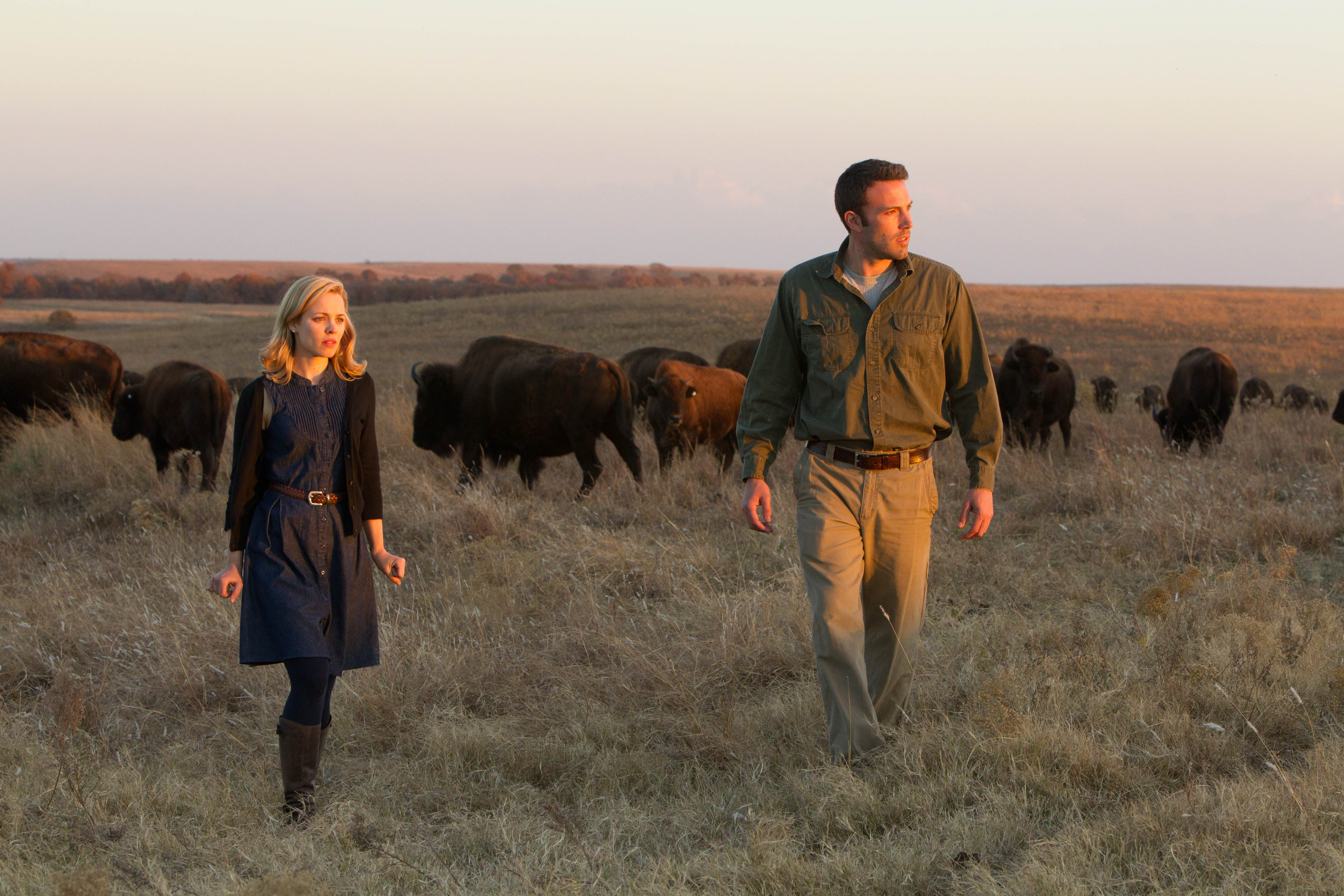
There are certain aspects of the film that are first-rate. The photography is fantastic. If they continue their collaboration, Malick and Emmanuel Lubezki might go down as one of the all-time great director/cinematographer combos. There are individual shots here that will take one's proverbial breath away. In particular, there's one particular shot of dancing light reflected off of a chandelier that literally made me sit up and stare at the screen in wonderment.
The performances by Kurylenko and McAdams deserve praise, particularly given how thin the plot seems to be. In particular, Kurylenko's performance is extremely solid. In the absence of dialogue, her face communicates a wealth of emotion.
I also really liked Bardem's character. In a time when Catholic priests certainly haven't been regarded in the most positive light, his character is a fundamentally good man who cares deeply about serving his community. While I liked the bits about his crisis of belief, I found myself surprised at how heavily the film comes to communicate a heavily Christian message toward the end. From what little I know of him, I believe that Malick is a Christian himself, but I found such a pointed message to be a bit of a strange choice, particularly given how universal the spiritual themes were in The Tree of Life.
Additionally, there are individual sequences that highlight Malick's abundant gifts as a filmmaker. In particular, the film's closing sequence is beautiful. It involves a woman walking, walking, walking before finally turning to see something. At that point, I felt as though I were in a place that I knew. I only wish that the rest of the film had seen that kind of cohesion.
Malick's come to a place where he's not terribly interested in conventional notions of plot and story structure. I understand (and applaud!) that. The problem arises when he doesn't leave enough bread crumbs for the viewer to be able to put the pieces together in any kind of a meaningful way. Here, as in The Tree of Life, Malick employs a kind of omnipotent perspective. While it mostly seems to move forward in one fairly consistent timeline, To The Wonder does skip around in a way that confuses things, particularly toward the end. In the face of many seemingly needless contradictions, my friend and I were abundantly confused about what the state of Affleck and Kurylenko's relationship was when the film ended.
I certainly don't regret seeing the film, but while a film from Terrence Malick is always worth the effort, To The Wonder seems to me to be a big missed opportunity. That said, I look forward to further reading and discussion in the hope I'll be able to find further illumination.
2 1/2 stars (out of 5)


