Showing posts with label David Lynch. Show all posts

Saturday, December 18, 2010

A Tale Told In Gasps


I gratefully acknowledge my good friend J for being a first-rate discussion partner after the screening.

I’ve been anticipating Black Swan for months. MONTHS. The studio’s release schedule is one that’s pretty tough to figure out. I don’t get why they’ve screened the film to high heaven at festivals and previews, building anticipation to a fever pitch, and then have put it out an inch at a time.

No matter. It’s gone wide now, and whether or not it finds its way to a large audience remains to be seen. Now, onto the matter at hand.

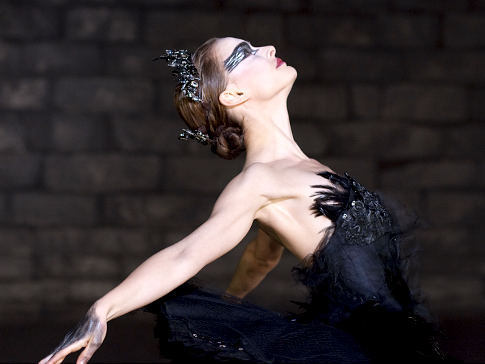
Black Swan is a crazy ride of a movie, filled with moments that alternately make the head tilt, the body cringe, and the heart flutter. Natalie Portman's performance is the best I’ve ever seen her give. Period. Not only do I think she’ll merit some serious consideration come the year-end awards process, but I also hope she wins, since my other favorite performance (Juliette Binoche in Certified Copy) probably won’t be eligible. While the rest of the cast is strong, this is Natalie Portman's movie.

Portman is Nina Sayers, a member of a successful ballet company. After the forced retirement of the company’s aging star (a strong Winona Ryder), Nina is cast in the title role in Swan Lake, and must portray both the chaste, serene White Swan and the wild, lustful Black Swan. Her struggle for perfection, present from the first frame, drives her mad as her role becomes reality.

To be honest, Black Swan isn’t quite the film I’d expected. I’m not sure if the superiority of the last half of the film is due to an increase in quality or to the first half laying tracks for the train. Who knows? Black Swan kept me guessing, and made me wince more than once, which is a lot more than I can say for most other films. I am more inclined to think that it’s a film that requires time to build traction and gain momentum to make its way to a climax. After having heard so much about it, I was surprised to see this. I’d anticipated the type of mindbender that would engross from the get-go, much like the way Mulholland Dr. enthralls from the opening frame.

Here, I stumble over my own thoughts. Both films are fairly “quiet,” allowing the viewer time to take a deep breath before sucking the air out of his/her lungs. However, they’re very different in the way they go about telling a story, and I’m not entirely sure how to describe the divide. Let's try this. . . both films put the viewer down in drastically different places than he/she had been picked up in the first place. Where David Lynch’s film is a lyrically hypnotic dream in which the nightmare is in found in waking up instead of going to sleep, Darren Aronofsky’s fever dream simmers, simmers, and finally boils until it’s consumed.

The validity of perception is one of the biggest questions raised throughout Black Swan. As a viewer, it’s so easy to get caught up in Nina’s struggle to keep her head on straight that it can become tough to keep an objective perspective. By objective, I’m not suggesting that the film experience should be a dry and boring one that’s approached like a reporter covering a bake sale. What I mean is that, by the end of the film, it dawns upon the viewer how little of the story may have really happened the way it initially appeared to. For example, Nina’s mother seems to be a very controlling person, leaving almost no part of Nina’s home life unregulated. It’s in the reexamination of the narrative that I began to wonder exactly how accurate my perception of her actually was. I mean, if I thought that A, B, and C were all true, and they were proved to be tied up in Nina’s delusions, then it’s logical to conclude that the ramifications could spread through the entire alphabet, right?

However, with Black Swan, I really do want to understand the subtleties of the narrative, and will watch the film again (if not several times) with the hope of gaining valuable perspective. Conversely, with Inception, 2010’s biggest "head trip" movie, I’m not particularly interested in trying to plumb its shallow depths to try and figure things out. I just don't really care.

Darren Aronofsky’s direction reminds me very much of his work on The Wrestler, particularly with his prolific use of Super 16mm and his fascination with following his characters from behind as they move from place to place. However, I’m not a big fan of his prolific use of hand-held cameras, though I did warm to them a bit, at least in the way he tried to film the dancing sequences so as to capture their sense of rhythm and movement. There was one specific instance where I felt that he was trying to unnecessarily punctuate a certain surprise moment. I got it the first time, Darren. No need to go for a “da-DUM!” It may seem like a minor quibble, but it does detract from the air of gravitas he’s trying to establish.

Through much of Black Swan, I found myself waiting for the thrills I’d expected to manifest early on. Let me tell you, when they hit, they come with a vengeance. The last 10 minutes or so is gripping cinema that's tautly beautiful. I’m inclined to think that the film’s ending is quite possibly a perfect one. I have a very small number of narrative endings that I consider to be perfect, and I wasn’t expecting Black Swan to find a way on that list. The conclusion thrilled me, but, much more than that, I was enthralled, blasted back in my seat, in the happy delirium of the satisfied cinephile.

Ahhhhhhhhh.

4 ½ stars (out of 5)

Tuesday, November 25, 2008

The mind is deceptive above all things

Last week was a different kind of week for me, cinematically speaking. Since graduating, I've been trying to catch up on the movies I should have already seen, but hadn't.

Oh, all right, I'll come clean.

I was one of those people who didn't take classes like American Film 1 or American Film 2 or World Cinema. You know, the kind of classes that make you watch 3 films a week, inhibit your social life, and force you to watch stuff you might not want to watch or be in the right mood for. Overcome by a tremendous, mind-numbing sense of guilt that's disturbed me to the point of not eating or sleeping, I've been trying to watch more of the movies that I would have watched in those types of classes. Besides, I was getting hungry.

So, in my comings and goings since graduation, I've watched films by Scorsese, Allen, Soderbergh, the Coens, Anderson, Kieslowski, and Mendes. But last week, like I said, was something different. Over the course of 48 hours, I watched two films that are so far out of the "mainstream" I'd be surprised that they even know what water looks like.


On Thursday afternoon, I went to see Charlie Kaufman's directorial debut, Synecdoche, New York. While Kaufman's been renowned for years as one of the most gifted writers at work in film today, this was the first time he stepped behind the camera to tell one of his own stories. I can honestly say that Synecdoche, New York is one of the strangest films that I've ever seen. It's been almost a week since I saw it, and I'm still not completely able to make heads or tails of it. I think it's one of those films that's attempting to make a grand point about human existence, and how we're all the same, my problems are the same as your problems, and the like. I'm not very sure if most (if not all) of the events in the film take place in the "real" world, a dream world, or something else altogether. On a positive note, Phillip Seymour Hoffman gives a terrific performance, and the supporting cast is solid. Unfortunately, Synecdoche, New York did something to me that most movies don't. It lost me.

I'm not suggesting that I never find myself confused by a film. That happens all the time. What was different about this film is I actually got to a point where I was ready for it to be done and wasn't willing to give it any more time. That doesn't usually happen for me with a movie I'm enjoying. To be honest, I really would like to understand Synecdoche, New York, because I think it's got potential on that front. Unfortunately, I don't feel like Kaufman gave me the tools to work on figuring it out for myself. He surprised me in how good a director he was, on his first attempt, no less. However, I wonder if he might not have been reaching too far with this one. So, did I like it? I don't know. I think the film needs to be seen by anyone who considers himself/herself a fan of the movies. Just be aware that it's Kaufman on steroids. If you thought Adaptation was somewhat labrythine, just wait.


The very next day, just when you were thinking my week couldn't get any weirder, (Come on, I know you were thinking that. . . at least, I would like you to have been thinking that. Same thing.) I watched David Lynch's Mulholland Drive. Wow. If you've never heard of Lynch, he's definitely an American original. Look at it this way: he's one of those people who, when you watch one his films, you know that he's either uncannily brilliant or just plain nuts. Could be a little of both. He's a surrealist, with a thing for old pop songs and beautiful people in bizzare settings. I quite liked Mulholland Drive for multiple reasons. First, after the frustrating experience that was Synecdoche, New York, seeing a film that was just as unique in a much more fulfilling way was refreshing. In particular, after doing my homework, I was able to understand the film, which is no small feat. It starts in a very clearly defined "world," continues that way for about 2 hours, and then, for the last 20 minutes, pulls out the rug and puts the viewer somewhere completely different. Second, the story is very compelling, and the two lead actresses, Naomi Watts and Laura Elena Harring, were perfectly cast. Harring, specifically, is great in the vulnerability that she shows in her role, not to mention the fact that she is a truly gorgeous woman in the tradition of an older brand of actress. There's a really terrific scene where the two of them go to a club and hear a singer (Rebekah Del Rio) sing an a capella version of Roy Orbison's "Crying." It was remarkably moving. Third, Mulholland Drive is nothing if not completely engaging, despite the way that it plays with the viewer and the viewer's expectations and ideas of what's "real."

So, I'd recommend you go out and catch Synecdoche, New York before it's completely out of sight. It's got the originality to power about 15 mainstream Hollywood movies. Let me know if you understand any of it. I'd be really grateful for the help. I have to say though, my personal favorite from "weird week" is definitely Mulholland Drive. Like Kaufman's film, it's not for everyone, but if you're a fan of art-house movies and mind-twisting stories, I wouldn't miss it.