
Showing posts with label Best of 2012. Show all posts

Wednesday, December 26, 2012

Amour - The Losing and the Letting Go


Sometimes, if you’re lucky, a film comes along that tells a part of your story. When that happens, it means a lot. Sometimes, in one’s own quiet expressions of grief, it’s profoundly moving to know that someone somewhere understands where your journey has led, and that you are not alone in your suffering. Amour is that kind of film.

Michael Haneke has made a living out of cinematic trickery and deceit for so long that it’s shocking to see him actually try to tell the “truth,” or at least his version of it. For a filmmaker who’s spent years imposing his will on audiences by routinely confounding everything they thought they'd learned,  Amour is a surprisingly heartfelt piece.

As a story of the breakdown of a body after a life-altering moment, the film gets the details right. The blank stare, the withering hand, the agonizing attempts to walk, the way that lips are held, the helplessness felt by the loved ones of the sufferer, the way that a person is lifted and manipulated so that they can perform basic functions, the crying out, the repetitive attention to specific details, the way that the caretaker’s body begins to feel the strain of having to repeatedly exert itself in heretofore unusual ways, they’re all here. More importantly, they’re all handled with a delicate touch that shows a great deal of respect to the reality of situations like this.

Emmanuelle Riva’s performance is one of the best that I’ve seen thus far this year. If there is no respect from the American Academy of Motion Picture Arts and Sciences . . . it will be a further sign of their irrelevance. Her performance doesn’t rely on histrionics or huge moments of expressed emotion. It’s in the little details that she finds a way to bring Anne to life. Her performance is a triumph by any standard, and one of the finest in recent memory.

Trintignant’s performance is good too, but it’s certainly not the equal of Riva’s. They're blessed with a wonderful chemistry. It's not difficult to believe that they've shared a lifetime's memories. There’s a moment when he’s trying to get her to drink water, and she doesn’t want to have any. He forces it into her mouth, and after she spits it back at him, he slaps her. Part of me wishes that that sequence was not in the film, but another part of me understands the kind of frustration that could lead a person to do something like that. There’s a unique pain/frustration that comes from trying to feed someone who does not want to eat. You know that, if they don’t eat, they’ll die, but, at the end of the day, there’s only so much that you can do. The human will is stronger than you realize. After the slap, she swallows. It might be one of the most heartbreaking things I’ve seen on a screen in a long time. She does it in such a defeated way, and it’s painful to see.
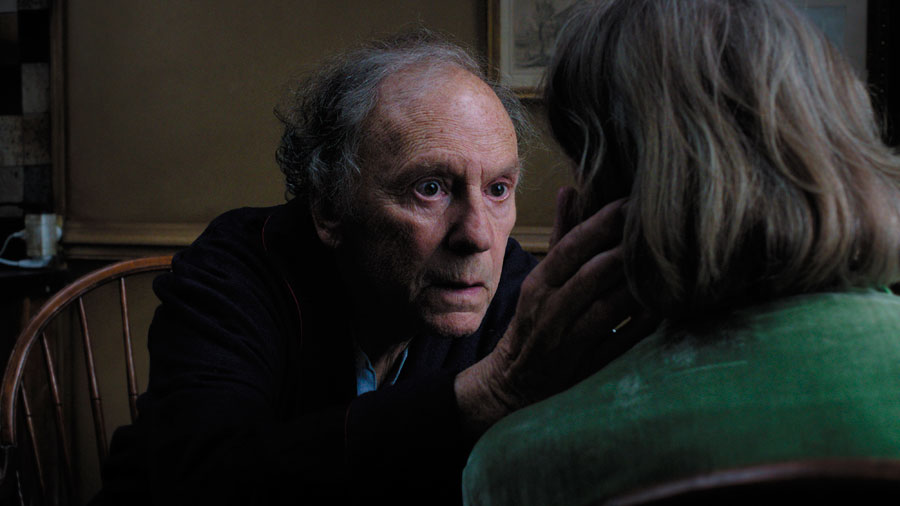
Isabelle Huppert, one of my favorite actors, does fine work as their daughter. She means well and wants to help, but just can’t understand. It’s hard to blame her. When she tells her father that he can’t keep doing this, he’s right to ask her the question he does. It’s so simple. “What should I do different? This is what I do when I wake up. This is what happens next. This is what happens after that. This is the exact structure of my day. This is what I have to face every single minute of every single day. What should I do differently?” It’s a scene that involves two people doing what they have to do, even though their ideas are at odds. She has to tell him what she does, and he has to respond as he does.

I know what she means about her father not continuing to face the day-to-day struggle, but he made a  promise to his wife that she’d not have to face any more hospital visits. He makes this promise even with the realization that more medical care will probably be a very necessary part of their lives. Even though a hospital can provide ten times better care than he can, he gives freely, even to his own hurt.

The love between Georges and Anne is special, born of time and common experience. The promise I mentioned is indicative of that. He gets to a point where caring for her himself is almost unbearably hard, but he promised. Simple as that. There are certain things that we owe to our loved ones that no amount of time or hardship can separate us from.

I also really liked the way that he deals with the incompetent nurse. “I hope that you have the misfortune to be treated exactly the way that you treat your patients when you are helpless.” It’s one of the most satisfying moments in the film. Prior to that, it was easy to see that this nurse wasn’t any good at her job and was causing more harm than good to the one person that she was supposed to be caring for. I just wasn’t sure if this fact was supposed to be self-evident to all. I don’t think that being gentle is difficult, particularly as I get older. There’s a strange way that certain people feel the need to belittle those that are different from their own experience. I don’t really understand it. If what my own life has taught me is to be believed, the people who matter most are rarely the people who get the best press. The quiet person who stands in the corner might be the best friend you have.


Haneke is still not entirely comfortable with the idea of a completely straightforward narrative, which might not be fair to him, as finding something you think you’re good at and sticking with it isn’t necessarily a form of weakness. However, his framing device is a gentler one than usual, and isn’t as reliant on him imposing his will upon the audience. Typically, a Haneke film ends with or is generously sprinkled with instances of his reminding the viewer that there’s someone pulling the strings and that that person doesn’t answer to anyone. Fortunately, here, it’s a bit more effective. I think that the ending most resembles Cache, but where that film was frustrating in its arbitrarily elusive turning of the screw, Amour’s ending holds up. It’s a quiet secret that’s spotted, unsurprisingly, in the details.

To say that I feel a sense of gratitude to Haneke, Riva, Trintignant, and Huppert would be an understatement. I’ve been looking forward to this film for years. I just didn’t know how much my own life would change in that period of time, or how closely my experience would be reflected in the narrative. Given how easily certain filmmakers/actors might have treated material like this in leaning toward melodrama at worst or sentimentality at best, it’s a blessing to see such restraint at work. Ultimately, the lack of sentimentality in Amour does the best service to the emotional integrity of the piece. In trying to avoid the creation of a disingenuously emotional experience, Haneke and his actors have found a way to express the most sacred of emotions with respect, conviction, and sincerity.

One of the very best films of the year.

Photobucket
4 1/2 stars (out of 5)

---
Amour was the recipient of the Palme d’Or at the 2012 Cannes Film Festival, as well as a host of other prizes. I think this is looking like a sure thing for Best Foreign Language Film at the Oscars, and would not be surprised to see it pick up additional nominations, including Best Picture. 

Monday, November 19, 2012

Lincoln


If I told you that Disney was distributing a Steven Spielberg film about Abraham Lincoln, and that that film would star Daniel Day-Lewis, you’d probably have a certain set of expectations as to what that film would be like. From a tonal perspective, Lincoln is very much the film that you’d expect it to be.

The costumes are immaculate, Tony Kushner’s dialogue is filled with the witty turns of phrase that seem to have gone out of the popular idiom in 1960, and the music swells exactly when you’d expect it to during certain speeches. There’s a bit of a PBS vibe to the film, but, fortunately, it manages to avoid being too heavily sanctimonious, mostly thanks to Kushner and Day-Lewis. The only significant difference from what one might expect from this project is in its narrow focus on a specific period of time. Rather than tell the story of Lincoln’s life, the film zeroes in on the period surrounding the attempt to abolish slavery in the United States through the passage of the 13th Amendment to the Constitution.

Where Lincoln succeeds best is in humanizing the man and in making the political conflict of the time seem relevant to the 21st century. All too often, Americans of this day and age seem to think that the current level of political vitriol and unwillingness to compromise are unique to our time, when that’s been anything but the case. Lincoln details the tightrope that Lincoln was forced to walk every single day. If he wanted to gain the full support of his own party for the Amendment, he had to agree to secret peace negotiations with the Confederacy. However, if word got out that he’d agreed to negotiate, he’d be labeled a liar and opportunist for trying to divide the country further by pushing for legislation that was divisive enough for “free states,” to say nothing of the potential contentious reintegration into the Union of the thousands of people who’d committed to fighting to protect their rights to own slaves.

There’s a tendency to idolize certain events and people long since relegated to the annals of historic heroism, and, insofar as American history is concerned, Abraham Lincoln is probably victim to that more than many. I can still recall the opening line of his entry in the first set of encyclopedias that my parents ever purchased for my sister and I. “Abraham Lincoln is one of the greatest men who has ever lived.” That’s a remarkably subjective statement for a text trying to establish a factual record. I could understand “most important” or “most influential,” but “greatest” implies a value judgment that you’d think has little-to-no place in an encyclopedia. Nevertheless, there it stands.

Daniel Day-Lewis’ performance is masterful. It’s all too easy to forget the actor and simply see . . . him. Given the time he lived in, Lincoln is not someone whom we’ve watched on television for years, as is the case with contemporary historical figures. That said, this portrayal is pretty much the embodiment of everything that one would expect of what Lincoln would be like. He’s funny and charming in a rustic way, but possesses a keen insight into the law and the delicate things that affect the political machine of the time turn one way or the other. Something that I hadn't expected was for him to be as warm of a person as Day-Lewis portrays him. He cracks jokes to lighten the mood, swears when things aren't going his way, and above all, has a deep and abiding love for his family. One of my favorite scenes features him asking two telegraph operators what they think about something in a display of simple candor.

Something that I really admire about Lincoln is its refusal to polish the pedestal too brightly. Lincoln was, by contemporary standards, a racist, even as he worked tirelessly to abolish what he considered to be a scourge upon American identity. There’s a pivotal scene where he discusses the implications of freedom with his wife’s black attendant and he tells her that he doesn’t really know her or members of her race but, he supposes that he will “get used to you.” It’s a moment of surprising nuance. Furthermore, Lincoln’s family life is given a pretty complex treatment in his relationship with his wife and their (not so) different responses to the grief of losing their son William. There’s a wrenching moment where he describes for the first time the pain he deals with on a daily basis.

Additionally, Tommy Lee Jones’ turn as Thaddeus Stevens pretty much steals every scene he’s in. There’s a wonderful moment where he’s forced to choose his words very carefully to support the Amendment without betraying his principles, and the balance he strikes is enough to make you pump your fist with a little theatrical celebration. The other performances are mostly fine too, with small parts for a ton of big names, but Day-Lewis and Jones are a cut above the rest. I’ll be up front. Daniel Day-Lewis deserves an Academy Award nomination at the very least. The only thing that’s keeping me from saying that he should win is that I want to wait until I’ve seen the other performances that might compete against him.

One of the emotions I felt most strongly in experiencing the film was sadness. In America today, the Republican Party is undergoing an identity crisis, as factions that want the party’s principles to adapt to changing times struggle against another faction that wants to take the GOP into ever more conservative territory. It’s sobering to remember that the Republican Party was once the party of emancipation and personal liberty, where it now seems committed to rewarding the wealthy and only affording equal rights to those groups, genders, and people that it approves of. It’s my sincere hope that the GOP finds a way to reclaim itself from those that would try to limit personal freedom and engage in exclusion.

Ultimately, Lincoln is the kind of film that one likes for sentimental reasons. There were a few occasions where the film choked me up, which seems to happen more and more as I get older. It’s not trying to reinvent the wheel or do anything that’s drastically different, opting to use a tried-and-true formula to tell the story of one remarkable man and the extraordinary times in which he found himself. After beginning the 21st century with a period of astonishingly prolific creativity, Spielberg has not crafted a masterpiece with Lincoln, nor has he made one of his more interesting films, but the film is comforting in the way that it offers rewards you just as you think it should. I’m grateful for that. 

4 stars (out of 5)

-------

If you're in the mood for more Spielberg, here's a look at one of my favorites. A.I. Artificial Intelligence (2001): Look Again. 

Sunday, September 30, 2012

Some Quick Thoughts on Looper


So, Looper is a really solid piece of work. It's rare that a modern film tackles sci-fi with anything resembling grit, but this is that flick. What's more, the time travel gimmick actually WORKS! My chief objection, namely that sending someone back in time to knock them off made a lot less sense than popping them a few in a back alley before going Fargo on the clean-up, was put to rest in the first 30 seconds. One of the main problems with time travel as a narrative convention lies in the inherent confusion that comes with playing with what happens to the future when the building blocks get re-arranged. The way that Looper handles things on that front is remarkably level-headed and above all, effective. As a huge Trekkie, I'm no time travel novice, but it was terrific to see a filmmaker worry less about tying his audience's head in knots and more about making sure that everything that happened as a result of Bruce Willis' trip down the rabbit hole makes sense. Little Pierce Gagnon is one to keep your eye on. I'm usually pretty tough on child actors, because there's only one Justin Henry, but this kid is pretty fantastic. He manages to handle the dichotomous part of an old soul in a vulnerable little boy's body to wonderful effect. Favorite line in the film: "Pass me the Phillips."