Wednesday, November 21, 2012

Podcasting: Lincoln


As happens from time to time, I was fortunate enough to be included on this week's discussion/breakdown of Lincoln on Out Now With Aaron and Abe. After our review of the film, the conversation moved to post-2000 Spielberg films, and let's just say that I was a bit surprised to realize exactly how much I love that period of his work.

You can listen to the entire podcast by clicking HERE to go to the episode's official page or by clicking the big ol' play button below.

Don't forget to share/post/link/tweet or whatever it is you do with things you like. Enjoy!

This episode features: 

Monday, November 19, 2012

Lincoln


If I told you that Disney was distributing a Steven Spielberg film about Abraham Lincoln, and that that film would star Daniel Day-Lewis, you’d probably have a certain set of expectations as to what that film would be like. From a tonal perspective, Lincoln is very much the film that you’d expect it to be.

The costumes are immaculate, Tony Kushner’s dialogue is filled with the witty turns of phrase that seem to have gone out of the popular idiom in 1960, and the music swells exactly when you’d expect it to during certain speeches. There’s a bit of a PBS vibe to the film, but, fortunately, it manages to avoid being too heavily sanctimonious, mostly thanks to Kushner and Day-Lewis. The only significant difference from what one might expect from this project is in its narrow focus on a specific period of time. Rather than tell the story of Lincoln’s life, the film zeroes in on the period surrounding the attempt to abolish slavery in the United States through the passage of the 13th Amendment to the Constitution.

Where Lincoln succeeds best is in humanizing the man and in making the political conflict of the time seem relevant to the 21st century. All too often, Americans of this day and age seem to think that the current level of political vitriol and unwillingness to compromise are unique to our time, when that’s been anything but the case. Lincoln details the tightrope that Lincoln was forced to walk every single day. If he wanted to gain the full support of his own party for the Amendment, he had to agree to secret peace negotiations with the Confederacy. However, if word got out that he’d agreed to negotiate, he’d be labeled a liar and opportunist for trying to divide the country further by pushing for legislation that was divisive enough for “free states,” to say nothing of the potential contentious reintegration into the Union of the thousands of people who’d committed to fighting to protect their rights to own slaves.

There’s a tendency to idolize certain events and people long since relegated to the annals of historic heroism, and, insofar as American history is concerned, Abraham Lincoln is probably victim to that more than many. I can still recall the opening line of his entry in the first set of encyclopedias that my parents ever purchased for my sister and I. “Abraham Lincoln is one of the greatest men who has ever lived.” That’s a remarkably subjective statement for a text trying to establish a factual record. I could understand “most important” or “most influential,” but “greatest” implies a value judgment that you’d think has little-to-no place in an encyclopedia. Nevertheless, there it stands.

Daniel Day-Lewis’ performance is masterful. It’s all too easy to forget the actor and simply see . . . him. Given the time he lived in, Lincoln is not someone whom we’ve watched on television for years, as is the case with contemporary historical figures. That said, this portrayal is pretty much the embodiment of everything that one would expect of what Lincoln would be like. He’s funny and charming in a rustic way, but possesses a keen insight into the law and the delicate things that affect the political machine of the time turn one way or the other. Something that I hadn't expected was for him to be as warm of a person as Day-Lewis portrays him. He cracks jokes to lighten the mood, swears when things aren't going his way, and above all, has a deep and abiding love for his family. One of my favorite scenes features him asking two telegraph operators what they think about something in a display of simple candor.

Something that I really admire about Lincoln is its refusal to polish the pedestal too brightly. Lincoln was, by contemporary standards, a racist, even as he worked tirelessly to abolish what he considered to be a scourge upon American identity. There’s a pivotal scene where he discusses the implications of freedom with his wife’s black attendant and he tells her that he doesn’t really know her or members of her race but, he supposes that he will “get used to you.” It’s a moment of surprising nuance. Furthermore, Lincoln’s family life is given a pretty complex treatment in his relationship with his wife and their (not so) different responses to the grief of losing their son William. There’s a wrenching moment where he describes for the first time the pain he deals with on a daily basis.

Additionally, Tommy Lee Jones’ turn as Thaddeus Stevens pretty much steals every scene he’s in. There’s a wonderful moment where he’s forced to choose his words very carefully to support the Amendment without betraying his principles, and the balance he strikes is enough to make you pump your fist with a little theatrical celebration. The other performances are mostly fine too, with small parts for a ton of big names, but Day-Lewis and Jones are a cut above the rest. I’ll be up front. Daniel Day-Lewis deserves an Academy Award nomination at the very least. The only thing that’s keeping me from saying that he should win is that I want to wait until I’ve seen the other performances that might compete against him.

One of the emotions I felt most strongly in experiencing the film was sadness. In America today, the Republican Party is undergoing an identity crisis, as factions that want the party’s principles to adapt to changing times struggle against another faction that wants to take the GOP into ever more conservative territory. It’s sobering to remember that the Republican Party was once the party of emancipation and personal liberty, where it now seems committed to rewarding the wealthy and only affording equal rights to those groups, genders, and people that it approves of. It’s my sincere hope that the GOP finds a way to reclaim itself from those that would try to limit personal freedom and engage in exclusion.

Ultimately, Lincoln is the kind of film that one likes for sentimental reasons. There were a few occasions where the film choked me up, which seems to happen more and more as I get older. It’s not trying to reinvent the wheel or do anything that’s drastically different, opting to use a tried-and-true formula to tell the story of one remarkable man and the extraordinary times in which he found himself. After beginning the 21st century with a period of astonishingly prolific creativity, Spielberg has not crafted a masterpiece with Lincoln, nor has he made one of his more interesting films, but the film is comforting in the way that it offers rewards you just as you think it should. I’m grateful for that. 

4 stars (out of 5)

-------

If you're in the mood for more Spielberg, here's a look at one of my favorites. A.I. Artificial Intelligence (2001): Look Again

Wednesday, October 24, 2012

Lana Wachowski Speaks

As the double-edged sword that is the social media machine simultaneously unites and divides our current (I hesitate to say "modern") civilization, it's become more and more customary to know what just about everyone who is anyone is thinking, feeling, or doing on any given day. As such, it's a rare thing to witness a major artist that maintains a commitment to privacy, much less anonymity. For years, the Wachowskis (of The Matrix Trilogy and V for Vendetta fame)  have been reluctant to make public appearances in support of their own films. Fortunately for them, their films typically do the kind of business that guarantees their success with or without the support of the director(s). 

However, with the release of Cloud Atlas, (which I'll be reviewing here very soon!) Andy and Lana decided to break their self-imposed embargo on the press and put themselves out there in support of the film. The introduction that they recorded with co-director Tom Tykwer for their mega-trailer was fun, breezy, and insightful, but it marked so much more than a long-awaited public appearance. This was the first time that Lana (formerly Larry) had appeared in public at all

Rather than use this space to tell you what I think this means, I've attached a video of a speech that she gave in accepting the Human Rights Campaign's Visibility Award. It's a very honest, often funny look at the way that her personal and professional lives have been defined by different opinions on how she should behave. 

More than that, it's deeply human. It meant a lot to me to hear these words. I thought you might appreciate them too.

Sunday, September 30, 2012

Some Quick Thoughts on Looper


So, Looper is a really solid piece of work. It's rare that a modern film tackles sci-fi with anything resembling grit, but this is that flick. What's more, the time travel gimmick actually WORKS! My chief objection, namely that sending someone back in time to knock them off made a lot less sense than popping them a few in a back alley before going Fargo on the clean-up, was put to rest in the first 30 seconds. One of the main problems with time travel as a narrative convention lies in the inherent confusion that comes with playing with what happens to the future when the building blocks get re-arranged. The way that Looper handles things on that front is remarkably level-headed and above all, effective. As a huge Trekkie, I'm no time travel novice, but it was terrific to see a filmmaker worry less about tying his audience's head in knots and more about making sure that everything that happened as a result of Bruce Willis' trip down the rabbit hole makes sense. Little Pierce Gagnon is one to keep your eye on. I'm usually pretty tough on child actors, because there's only one Justin Henry, but this kid is pretty fantastic. He manages to handle the dichotomous part of an old soul in a vulnerable little boy's body to wonderful effect. Favorite line in the film: "Pass me the Phillips."

Saturday, September 29, 2012

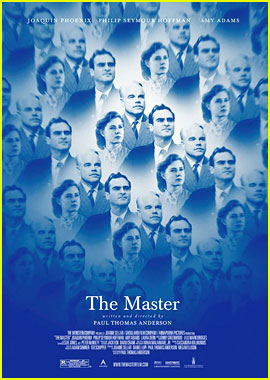
The Master - Here We Go 'Round the Mulberry Bush

I've been indirectly anticipating Paul Thomas Anderson's next film since the release of There Will Be Blood in late 2007. That film is perhaps the greatest single piece of work in the career of one of cinema's greatest contemporary talents. Part American epic, part fever dream, it's a true tour de force from Anderson, Daniel Day-Lewis and Paul Dano that deserves its own place in the cinematic canon.

As such, The Master seems to have a lot going for it. Anderson's star has never been higher, and Joaquin Phoenix is finally back to acting after his lost weekend with Casey Affleck. The rest of the cast includes such fine actors as Phillip Seymour Hoffman and the delightful Amy Adams. Master musician Jonny Greenwood (of Radiohead fame) is back to score the film . . . and the whole thing is a look at what leads a person to join a cult. This is a potentially devastating combo.

And it just doesn't work out in the end.

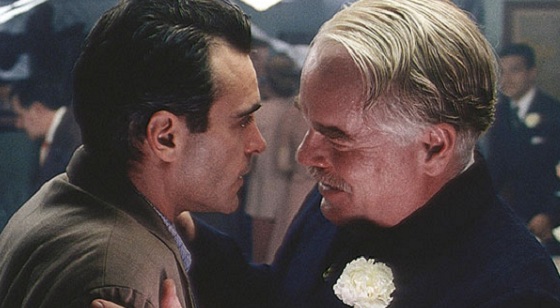
Now, the film's paced well, moves briskly, and never feels like it's sinking under its almost 2 1/2 hour length. The performances are solid, with particular kudos belonging to Joaquin Phoenix for a strong turn as a mentally unstable man at the mercy of Hoffman's brand of quack science. It's a physical performance that requires him to give the impression that an angular, disjointed body is at the mercy of a tormented mind. Amy Adams is really good. Hoffman's all right, even if his "Uncle Snappy" routine doesn't really stretch him in any direction that's particularly groundbreaking. Mihai Malaimare Jr.'s photography is lovely, and Anderson's direction is strong, which shouldn't surprise anyone.

But The Master doesn't go anywhere, and that's a big problem. Now, I'm a vocal opponent of the Church of $cientology, and I'm thrilled that an artist of Anderson's stature was inspired to use that particularly nefarious organization as dramatic fodder. Make no mistake. That's exactly what's happened. Despite assurances from the team that this is not directly related to L. Ron Hubbard's soul-crushing, life-destroying moneymaking machine, The Master is clearly intended to be an attack on $cientology. Terms may be changed, and names might be different, but if you know what to look for, it's there in spades. 

Despite its good intentions, I felt cheated when the film ended. There's just no real resolution to the story. I don't know what Hoffman's Lancaster Dodd wanted from Phoenix's Freddie Quell. I don't know if he honestly thought that he could help Freddie, if he was preying on a weak mind, or if some strange combination of the two was at work. I don't know why Freddie didn't see through the pseudo-scientific psychobabble he was constantly exposed to. I don't know why the last interaction the two have is so strange. There are those who feel that the final act of There Will Be Blood is at complete odds with the rest of the picture. I've never been one of those people, but here, I do not understand what's supposed to be gained from the truly bizarre series of final events that roll around.

Even despite the fine casting, the performances don't really allow for much emotional engagement with the characters, which is a curious thing. Even the performance I liked most (Phoenix) relies on a certain level of physical gimmickry to be effective. It's difficult to avoid the obvious comparisons with Daniel Day-Lewis, but I'm also reminded, strangely enough, of the female leads in 2010's Never Let Me Go. Keira Knightley seems to need quirky characteristics to make Ruth tick. Carey Mulligan just is. There's not a note of falsity in her performance. She's (in a relatively short time) found a way to perform in a state of being that's immediate, affecting, and remarkably genuine. I'm not suggesting that Phoenix's work isn't strong, only that it's not good enough to transcend the material and fully engross the viewer. You keep noticing the little things that the performer's bringing to the performance, instead of allowing the performance to sink into a larger cohesive experience.
I'm right on the fence here. I can't deny that the film's fairly absorbing for much of its running time, but I found myself waiting for a knockout punch that just never came. The Master provides for an interesting experience that proves ultimately thankless, and that's a really frustrating thing. If you love Paul Thomas Anderson, you'll want to see this for that reason alone, but otherwise? I can't really recommend the film beyond that.

3 stars (out of 5)

---

With the noble aspirations of a film attempting to tackle a large problem in mind, I respectfully ask you to Google the name "Lisa McPherson."

Friday, July 27, 2012

Podcasting: The Dark Knight Rises, Part 2


With the arrival of The Dark Knight Rises, a film that's transcended the simplicity of the calendar year to become a bonafide event, the good gentlemen at Out Now With Aaron and Abe decided that one episode wasn't enough. While Part 1 was designed from the outset to be completely spoiler-free, the crew really wanted to delve into the particulars of the plot and speak off the cuff, without fear of ruining the experience for the uninitiated. 

Part 2 is that conversation/breakdown/marathon. It's chock FULL of spoilers, so if you haven't seen the film, you've been warned. Don't be an idiot. 

You can listen to the entire podcast by clicking HERE to go to the episode's official page or by clicking the big ol' play button below.

Personally, I think this one might be one the show's finest hours yet. Enjoy!

This episode features: 

Wednesday, July 25, 2012

Podcasting: The Dark Knight Rises, Part 1


Just about everybody affiliated with Out Now With Aaron and Abe has had The Dark Knight Rises at or near the top of their most anticipated list for 2012, so it's no surprise that we've taped not one but TWO episodes devoted to the film. You can listen to the entire podcast by clicking HERE to go to the episode's official page or by clicking the big ol' play button below. 

FYI, this episode is spoiler-free. Part 2 (with an abundance of spoilers!) is coming soon, so keep a weather eye out. . .

This episode features: 

Friday, July 20, 2012

The Dark Knight Rises - Batman Fall Down Go Boom


I’m going to do something that I’d never have imagined doing, and compare Christopher Nolan’s Dark Knight Trilogy to Francis Ford Coppola’s Godfather Trilogy. Sure, it’s not an exact correlation, as The Godfather and The Godfather, Part II are widely considered to be two of the finest films ever made, and I don’t think that many would suggest that even the finest of the most recent Batman films come anywhere close to equaling them. What I do think, however, is that an examination of the overall arc of each respective trilogy proves a bit more telling than you might think. If The Godfather/Batman Begins serve as the origin story, then The Godfather, Part II/The Dark Knight illustrates what happens when the established order of things comes crashing down and must be re-structured. With the first two Godfather films and Nolan’s first two Batman films, there’s a strong sense of time and place that come together beautifully. They just feel right. They belong together.

It’s not exactly a fair comparison, and I acknowledge that. Even at their best, Nolan’s Batman films are still about a guy who dresses up like a bat to go swinging from rooftop to rooftop, fighting crime with the aid of a motley crew of supporters, and, as such, there’s a fair level of far-fetched content that comes with the territory. Additionally, there’s a substantial backstory that’s got to be done justice here, with even minor characters needing to be handled just so.

Unfortunately, that also means that The Dark Knight Rises is this trilogy’s The Godfather, Part III.

This is one of the more disappointing films in recent memory, and it’s truly unfortunate, particularly after the goods that came before. Even though I have my issues with both of the series’ previous entries, I can’t deny that The Dark Knight is easily one of the finest superhero films of all, with a final 90 minutes that moves like freight train to a thoroughly unexpected and almost entirely satisfying conclusion. That said, The Dark Knight Rises has a simplistic script that relies on a fairly generous level of convenience and a lot of old-fashioned youvetakenthisasteptoofar-ism.

It’s ironic, because certain things that I didn’t think would play all that well ended up playing far better than I’d anticipated, and other things that I thought would be handled masterfully came across like lead balloons.

First, the good. I was very surprised to find that Anne Hathaway is a really solid Catwoman! Who knew? I’ve been in the “it should have been Angelina” camp since they started accepting members, but I was really pleased at how well Hathaway fills the ears and high heels. The character manages to maintain a fair sense of ambiguity with relation to her motives, and has some twists and turns that are really surprising. Just when you think you have her pegged, you realize that you really don’t. I’m also very happy that she’s never verbally referred to as "Catwoman." There was no need to take it in that direction, and the brothers Nolan didn’t. Her interplay with Batman provides for some of the most entertaining bits in the film.

Michael Caine’s turn as Alfred is his finest of the series. With the arrival of 2005’s Batman Begins, it took me a while to get used to him in the role, particularly after Michael Gough’s fine work in the Burton/Schumacher series. Wow. Caine’s work in The Dark Knight Rises is something else. While there’s still a bit of him filling one of Nolan’s pet parts as the character who rattles off long bits of exposition to fill the audience in on stuff, he’s wonderfully emotional at key points and serves as the film’s heart. He cares so much more about the young man that he’s loved since birth than he does the fate of a city, and it’s wonderfully moving.  I wouldn’t be entirely surprised to see Michael Caine end up with an Academy Award nomination. It might be a long shot, but I’d really like this to happen.

Also, with the entire narrative revolving around Batman’s fall and eventual rise (a few times over!), there are some genuinely spine-tingling moments when he gets back in the saddle again and comes around to save the day.

Now for the troubling bits . . .

There’s just far too much here that doesn’t really work. The idea of the series finishing off with Batman/Bane faceoff was one that filled me with an endless amount of excitement. He’s one of the single best villains in the Batman universe, but he’s just not that scary here, and his grand plot to reduce Gotham City to anarchy before it ends up in ashes works a lot better conceptually than it does on the silver screen. I think that the large shadow of the Joker is a bit of the problem here. The unstoppable combination of Heath Ledger’s masterful performance and a wonderfully written character provided for one of modern cinema’s finest villains in The Dark Knight. He had no limits, no fear, and no rules, and that made him ridiculously scary. From moment to moment, the viewer has no idea what he’ll do, and, what’s more, Batman has no way of controlling someone who’s not afraid of him. He’s the true anarchist of this trilogy. Bane, sadly, just doesn’t live up. He’s a “terrorist” who has an interesting connection to the League of Shadows, which provides for an endless amount of possibilities that just don’t really do that much. Additionally, the film has a way of giving you things and then jerking them right back. I’d say more (and will later), but cannot go into much detail here at the risk of spoiling things.

Furthermore, there are other things that JUST DON’T WORK. For example, did you know that now Batman sees visions? I didn’t either. It’s a foolish idea. If what he’d seen had been real, it’d have easily been one of the best moments in the film. Instead, its inclusion in the film makes no logical sense at all, aside from being a narrative device/old Nolan standby to give Batman (and subsequently the viewer) more information. What else? Bruce Wayne apparently suffered a severe leg injury that leaves him walking around with a cane throughout the early going, but is that explained? No, it’s not. The majority of the Dark Knight Trilogy takes place in the evening/twilight/night because that’s where Batman works best, right? Well, not here. Once the nuclear bomb subplot takes precedent, we end up in a whole lotta daylight, and that’s a strange thing from a visual standpoint, because Batman WORKS AT NIGHT. Take, for example, the mid-film sequence where Batman makes his first appearance in Gotham in 8 years. It’s a fantastic nighttime bit on the Batpod with Batman swooping in to clean up after the Gotham PD (again) that ends up with every police car in the city on his trail. It makes full use of the palate of nighttime colors, particularly those lovely flashing police lights, to put the Batman back where he belongs. Conversely, the final battle in the film takes place in broad daylight, and it’s just tougher to buy into the whole thing when you’ve got a dude running around dressed up like a bat at 2:00 in the afternoon.

Also, what’s the single greatest thing that Batman has going for him? His anonymity. Well, the number of people who seem to know who he is in The Dark Knight Rises is unprecedented. What’s more, even when a key character clearly HAS to know that it’s Bruce Wayne underneath the cowl, that person still seems shocked to finally learn the news for the “first” time.  

The single biggest problem that I have with The Dark Knight Rises is the ending, which is surprising. Going in, I was most excited to see what would happen at the film’s conclusion, because I really felt that all bets were off insomuch as to where the character might end up and what he might have to do to fulfill his destiny. Unfortunately, all it amounts to is one big cheat. Certain things are asked (and given willingly) by the viewer only to have them tossed back in the lap in a way that seems cloying and shallow. I would think that Nolan would be a smart enough guy to know that once you give someone a slice of chocolate cake, they’re going to be a bit angry to find out that it’s tofu about three bites in. Unfortunately, I guess he doesn’t, but I suppose that I ought to have been prepared for that, given Inception’s lackluster limp across the finish line.

Ultimately, I end up back at The Godfather, Part III. On its own, it’s not bad. It’s in the comparison with what came before that it suffers so badly. It’s a decent film, but a terrible Godfather film.

By the same token, The Dark Knight Rises isn’t a bad movie, but when you compare it to the previous films in the trilogy, it just doesn’t hold water.

Oh, what might have been. . .

2 ½ stars (out of 5)